Odoo vs Salesforce: Choose the right CRM for your business in 2026
Published on August 4th 2025
Odoo CRM: Flexible, Modular, and Built for Businesses that Move Fast
Odoo CRM sits within the broader Odoo ecosystem, an ERP-first platform known for its modular architecture, easy configuration, and open-source adaptability.
For businesses comparing Odoo CRM vs Salesforce CRM, here’s what stands out immediately for us:
Odoo adapts to your workflows. You don’t adapt to it.
Why Odoo Works for Growing Teams?
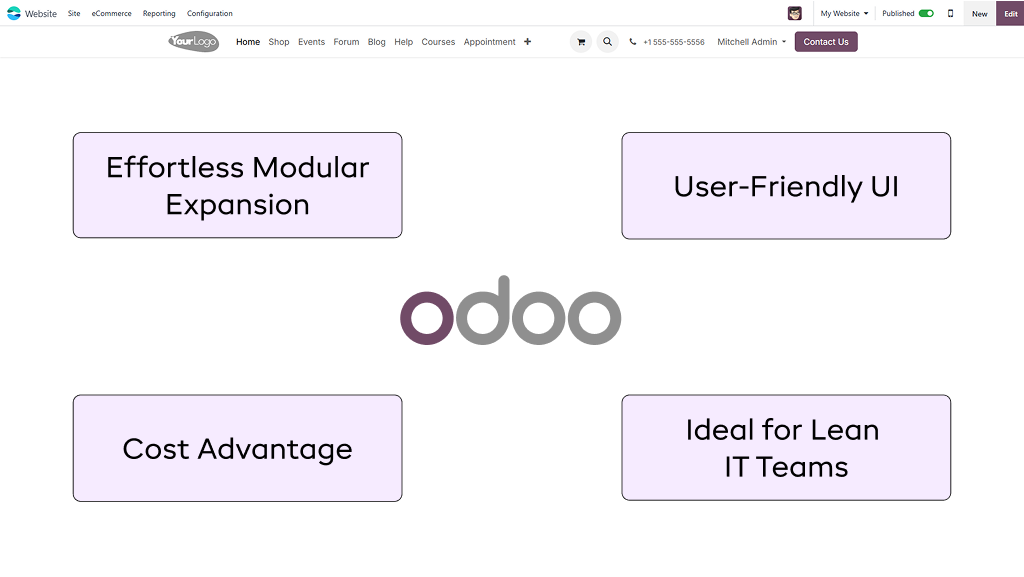
Effortless Modular Expansion
You can start with a handful of apps and expand as your processes mature. This is why Odoo is often the default choice for phased ERP + CRM implementations.User-Friendly UI
Teams adopt it faster because it feels familiar from day one. Your team requires less training, faces fewer blockers, and experiences smoother onboarding.Cost Advantage
Odoo keeps your total cost of ownership low. You can grow capabilities without paying enterprise-level licensing fees.Ideal for Lean IT Teams
Configuration stays simple with minimal technical overhead. You don’t need a heavy admin team just to maintain the system.What You Should Be Prepared For?
Odoo’s flexibility can become complexity if you are not able to manage it well.
To get lasting value, you’ll need either:
- An experienced internal IT team
- A strategic Odoo implementation partner who manages customizations, scaling, and upgrades in phases.
Because without the proper structure, Odoo can become difficult to operate over time.
What Do We See New for 2026?
Many companies now run Odoo + Salesforce together, especially when operations sit on Odoo and sales teams operate on Salesforce.
Thanks to smoother connectors and more stable APIs, Odoo Integration with Salesforce is no longer a workaround. It’s an easily configurable architecture.
Salesforce CRM: Enterprise Grade, AI-Driven, and Built for Scale
Salesforce continues to lead the enterprise CRM market, and for 2026, its advantage is clearer than ever:
It’s engineered for large-scale, multi-team, and compliance-focused organizations.
If you are searching for Salesforce vs Odoo CRM, here’s the real differentiator:
Salesforce is a full-scale CRM platform designed for sales, service, analytics, and AI automation ecosystem.
Why does Salesforce work well for larger organizations?
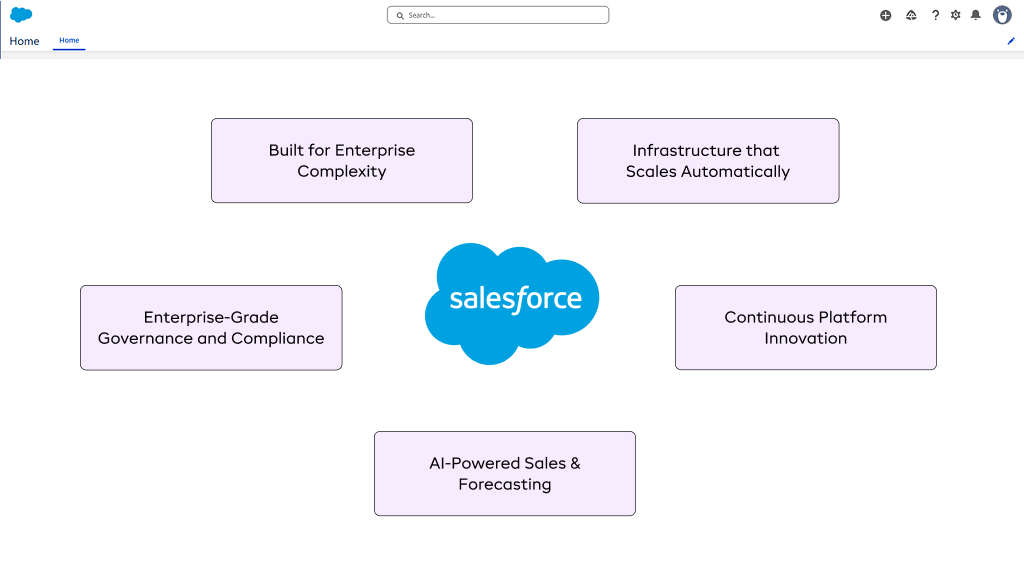
Built for Enterprise Complexity
Whether you’re running a multinational organization with multiple divisions or high-volume operations, Salesforce handles it without re-platforming.Infrastructure that Scales Automatically
With its cloud-based platform, robust API ecosystem, and extensive AppExchange marketplace, Salesforce makes it easy to expand functionality without hitting technical roadblocks.AI-Powered Sales & Forecasting
Einstein AI brings predictive scoring, forecasting accuracy, automation, and unified insights, which are completely out of the box.Enterprise-Grade Governance and Compliance
From HIPAA to FISMA to detailed audit trails, Salesforce is built for regulated industries, ensuring that even the most complex organizations stay secure and audit-ready from day one.Continuous Platform Innovation
Providers within the Salesforce consulting ecosystemensure platform updates, certifications, and partner alignment keep the system evolving to meet the changing enterprise needs.What You Should Be Prepared For?
While Salesforce offers a unified, enterprise-grade CRM platform, it requires a level of commitment and organizational readiness to make it valuable for your organization.
- Strategic alignment: Salesforce works best when teams are prepared to centralize processes and data on a single platform, driving consistency across the organization.
- Dedicated expertise: Most deployments require certified Salesforce admins or external consultants to fully leverage the platform’s capabilities and ensure the platform is configured and optimized for complex business needs.
Salesforce is a powerful platform. But it expects the maturity of the team that uses it.
What Do We Expect New for 2026?
We are seeing increasing usage of hybrid CRM. Enterprises are now combining the power of Salesforce with Odoo, where:
- Salesforce powers the sales, marketing, and services
- Odoo powers inventory, procurement, manufacturing, and operations
In short, the Salesforce Odoo Integration pattern is something we see as one of the fastest-growing architectures in the coming years.
What’s Next: From Salesforce vs Odoo Decision to Deployment
By now, you would have realized that picking between Odoo CRM and Salesforce CRM is just the first step. The next step is moving from “decision” to “deployment” with clarity and structure.
Here’s how we recommend you approach the transition:
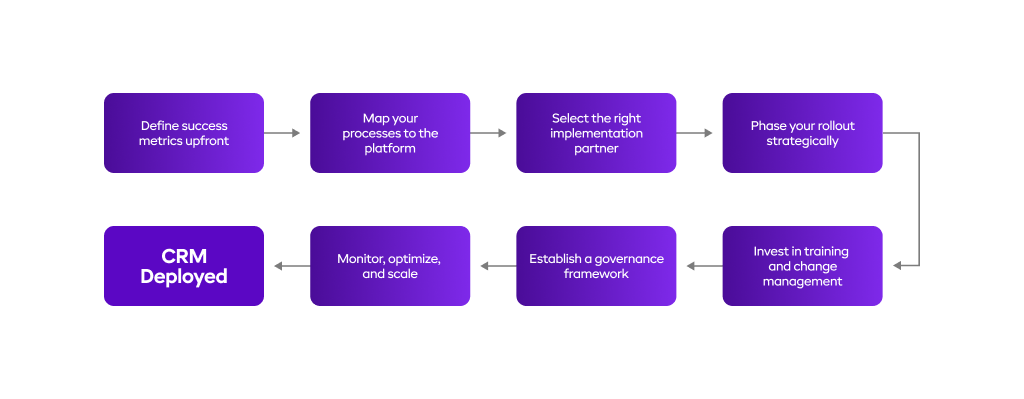
1. Define success metrics upfront
Whether it’s improving lead conversion rates, shortening sales cycles, or improving reporting visibility, establish clear KPIs for your CRM implementation.
Why it matters: This step ensures your implementation is outcome-driven.
2. Map your processes to the platform
Document your current sales, service, and operational workflows. Identify where the CRM will replace, refine, or automate existing steps.
Why it matters: A successful CRM deployment is about aligning the software with the way your teams work.
3. Select the right implementation partner
Whether you’ve chosen Odoo or Salesforce, the right implementation partner is critical. For Odoo, this often means a partner experienced in modular deployments. For Salesforce, it’s about certified consultants who understand enterprise-scale configuration.
Why it matters: The right partner accelerates time-to-value and ensures your CRM is built for scale from day one.
4. Phase your rollout strategically
We recommend starting with high-impact teams or modules (like sales pipeline management) and expanding gradually into other areas such as service, analytics, or integrations.
Why it matters: Phased rollouts reduce disruption and build internal adoption step by step.
5. Invest in training and change management
Even the best CRM fails without adoption. Build a structured onboarding program for your teams, backed by clear documentation and ongoing training.
Why it matters: CRM success depends on people, and not just the platform implementation.
6. Establish a governance framework
Whether it’s an IT lead for Odoo customizations or a Salesforce admin for enterprise governance, define who owns the CRM internally.
Why it matters: Strong ownership keeps your CRM optimized and prevents “configuration drift” over time.
7. Monitor, optimize, and scale
Once live, track your success metrics and refine your setup. Add modules, automation, or integrations in line with evolving business needs.
Why it matters: A CRM is not a one-time project. It’s a platform for continuous growth.

About Author
Delivery Head at Uncanny Consulting Services. With 10+ years of experience across ERP, eCommerce, and AI, Jigar has delivered 100+ projects in 15+ countries. Follow him on LinkedIn for expert insights on Odoo, Shopify, and digital transformation.

Delivery Head at Uncanny Consulting Services. With 10+ years of experience across ERP, eCommerce, and AI, Jigar has delivered 100+ projects in 15+ countries. Follow him on LinkedIn for expert insights on Odoo, Shopify, and digital transformation.