Odoo ERP for Manufacturers: Reduce Downtime & Boost Production Efficiency
Published on June 9th 2023
Introduction: “Nothing Is Broken… But Why Does Everything Feel Harder?”
This is how manufacturing problems usually start. Quietly, gradually, and without a single point of failure. Before anyone calls it a problem, everyone just feels the friction.
“Production is running fine,” the plant manager says.
“We shipped everything this week,” sales responds.
“Inventory is under control,” procurement adds.
Then someone from finance asks a quieter question, “Why are margins dropping?”
If you manage manufacturing operations, this probably sounds familiar. Nothing is visibly broken. Machines are running, orders are shipping, and teams are busy. Yet planning takes longer, numbers rarely match perfectly, and every department seems to be working with a slightly different version of reality.
At Uncanny, we work closely with manufacturing teams to bring structure, visibility, and control back into day-to-day operations using Odoo ERP.
In this blog, we break down the real challenges that slow manufacturing down as it grows, explain how Odoo ERP addresses them in practice, and help you understand what it actually takes to streamline production, inventory, finance, and coordination across teams.
What Really Happens as Manufacturing Operations Grow
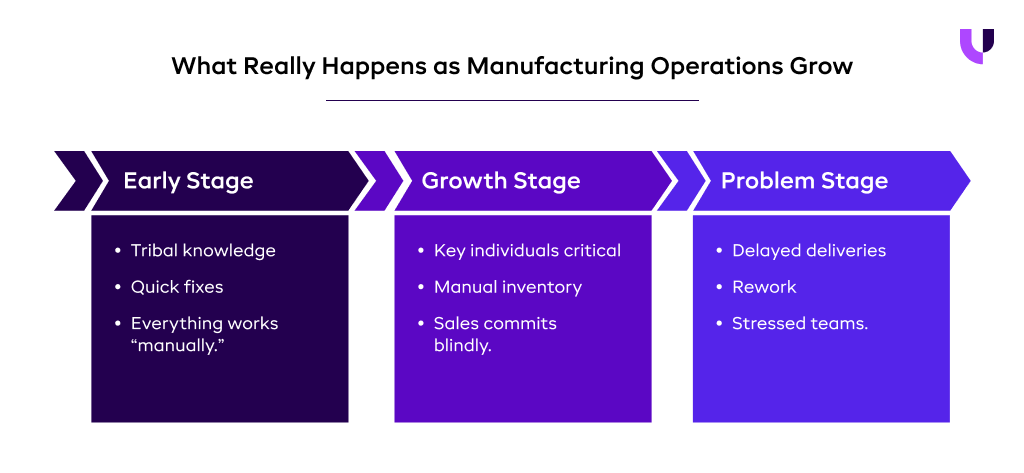
Growth brings volume, variety, and complexity. What once worked through informal coordination now starts demanding structure and shared visibility.
In the early stages, you rely heavily on tribal knowledge. Your team knows where materials are stored. Planners remember machine constraints. Small issues are resolved through quick conversations across the floor.
As volumes increase, that approach starts to crack. Production planning depends on a few key people. Inventory accuracy relies on manual updates. Procurement orders materials based on past experience instead of actual demand. Sales commits to delivery timelines without clear visibility into capacity. None of this feels alarming at first, but over time it shows up as delayed shipments, excess stock, rework, and teams constantly under pressure.
You do not look for an ERP because you want complexity. You look for it because coordination becomes impossible without a shared system that everyone can trust.
Want to start a project with us?
Empowering businesses to achieve greatness through strategic guidance and innovative solutions.
Book A Demo
The Real Manufacturing Challenges Odoo ERP Is Built to Solve
Most manufacturing problems do not come from a lack of effort. They come from systems that cannot keep up with how fast operations evolve.
Odoo ERP is designed to address these everyday operational challenges where things look fine on the surface but break underneath.
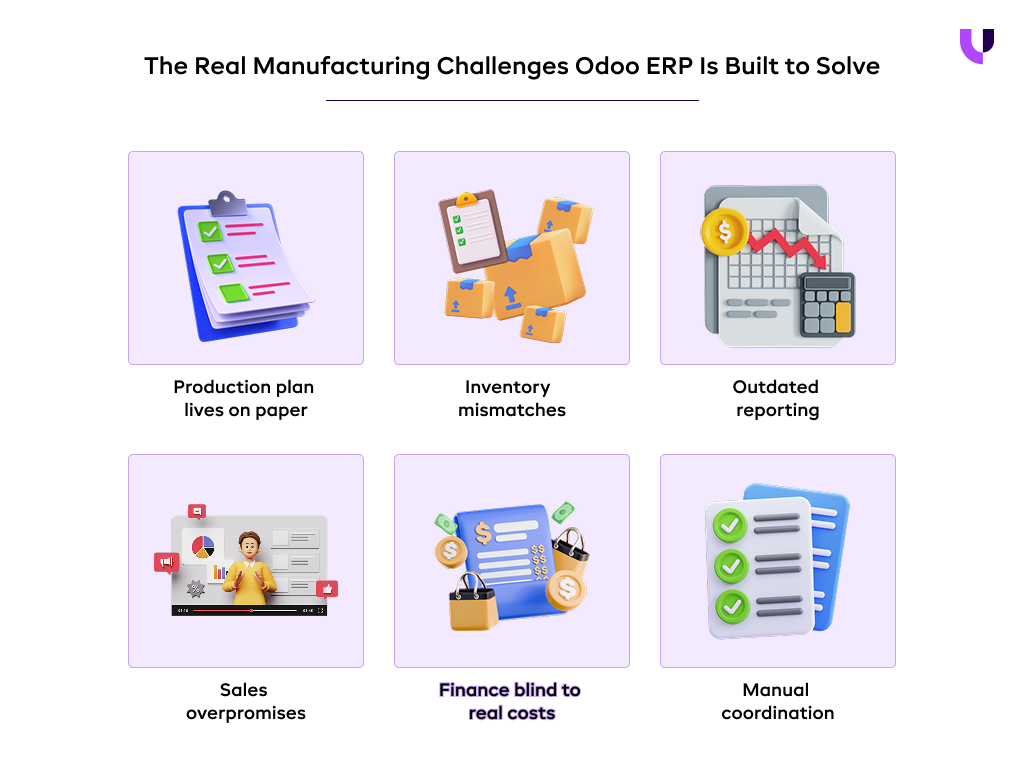
Challenge 1: Your Production Plan Exists on Paper, Not on the Shop Floor
In many setups, you create production plans in spreadsheets or planning tools that live far away from actual execution. Once the plan is shared, the floor starts working, and the plan rarely gets updated again.
When a machine goes down, a batch takes longer than expected, or a priority order comes in, you often hear about it too late. By then, delivery dates are already under threat, and replanning feels like starting from scratch.
How Odoo ERP helps you:
Odoo connects production planning directly to execution. Work orders, routing, and work centers update in real time as production progresses. When something changes on the floor, you see it immediately and can adjust schedules without rebuilding the entire plan.
Real-world example:
If you are running a mid-sized components plant and planning weekly in Excel, a single disruption can derail the whole week. Teams using Odoo update work order statuses live, allowing you to rebalance workloads the same day instead of reacting after delays pile up.
Challenge 2: Your Inventory Looks Right in the System but Wrong in Reality
This is one of the most expensive problems you face. On paper, materials are available. On the shop floor, they are missing, already consumed, or sitting in the wrong location.
You end up with last-minute procurement, production stoppages, and teams blaming each other instead of fixing the root issue.
How Odoo ERP helps you:
Odoo gives you a single, real-time inventory view across procurement, production, and warehouses. When materials are reserved for a production order, they are immediately unavailable elsewhere. Stock movements are recorded automatically as production progresses.
Real-world example:
If you run a packaging facility that frequently halts production despite healthy inventory reports, Odoo’s reservation logic ensures materials are allocated to jobs upfront. This reduces stoppages and eliminates emergency purchasing. Read how one electronic components manufacturer overcame operational inefficiencies and scaled seamlessly using Odoo ERP.
Challenge 3: You Are Making Decisions Using Outdated Reports
When you rely on end-of-day or weekly reports, you are always reacting. By the time you review the data, the situation has already changed.
This creates a culture where problems are discussed after the impact has already been felt by customers and operations.
How Odoo ERP helps you:
Odoo provides real-time dashboards showing production status, inventory levels, procurement progress, and costs. You see what is happening right now, not what happened last week.
Real-world example:
If you manage a contract manufacturing operation, weekly delay reports often arrive too late. With Odoo dashboards, supervisors spot bottlenecks mid-shift and reassign work before delivery timelines slip.
Challenge 4: Sales Commits to Timelines Your Production Cannot Meet
Your sales team wants to close deals, but without visibility into capacity and inventory, they often commit delivery dates that production cannot realistically support.
This creates internal tension and damages customer trust.
How Odoo ERP helps you:
In Odoo, sales orders are directly connected to inventory and production planning. Before confirming an order, your sales team sees availability and lead times. Production gets early visibility into upcoming demand.
Real-world example:
If you manufacture industrial equipment and struggle with missed delivery dates, Odoo ensures confirmed sales orders automatically feed into production planning, reducing surprises and improving customer confidence.
Challenge 5: Finance Cannot See What Is Really Happening on the Floor
Your finance team often works with estimates. Work-in-progress values are approximated. Margins are calculated after production ends instead of while it is happening.
This delays corrective action and hides cost leaks until it is too late.
How Odoo ERP helps you:
Odoo links production events directly to accounting. Material usage, labor, and overhead are recorded as production happens. WIP and costing update automatically.
Real-world example:
If you only discover margin issues during month-end close, Odoo allows your finance team to track costs in near real time and adjust pricing or sourcing decisions earlier.
Challenge 6: You Rely Too Much on Manual Coordination Between Teams
When systems are disconnected, coordination depends on emails, calls, and meetings. Decisions slow down, and operations become dependent on specific individuals.
This does not scale as your business grows.
How Odoo ERP helps you:
Odoo creates a shared operational system where sales, production, procurement, inventory, and finance all work from the same data. Updates flow automatically across teams.
Real-world example:
If your teams depend on daily coordination calls just to stay aligned, Odoo reduces that dependency by giving everyone the same real-time view, freeing time for actual improvement work instead of constant alignment.

Why Odoo ERP Fits Manufacturing Operations So Well
Manufacturing rarely follows a straight line. Demand shifts, suppliers change, machines break, and priorities move mid-week. An ERP fits only when it bends with your operations instead of forcing you into rigid processes.
Odoo works well for manufacturing because it is designed to adapt to how factories actually operate, grow, and change over time.
It Adapts to Different Manufacturing Models Without Forcing Change
Your manufacturing setup might be make-to-order today, make-to-stock for certain SKUs, or a mix of both. That flexibility is hard to support with rigid ERP systems that assume one standard process.
Odoo allows you to configure production flows based on how you already operate. You can support different product types, order strategies, and planning logic within the same system. As your model evolves, the ERP evolves with you instead of needing a replacement.
This is one of the biggest reasons manufacturers feel comfortable adopting Odoo without disrupting existing operations.
It Replaces Disconnected Systems With One Shared Source of Truth
When production, inventory, procurement, sales, and finance run on separate tools, coordination becomes manual. People spend time reconciling numbers instead of acting on them.
Odoo brings all manufacturing functions into a single platform. When something changes in one area, the impact is visible everywhere else immediately. You stop managing versions of data and start managing operations.
That shared visibility is what makes day-to-day coordination easier as volume grows.
It Scales With Your Factory Instead of Locking You Into Big Rollouts
Many manufacturers delay ERP adoption because they fear a large, disruptive implementation that slows production.
Odoo allows you to start with only what you need today, as seen in this industrial equipment supplier success story, where phased implementation helped streamline operations and integrate core functions without disruption. You might begin with inventory and manufacturing, then add quality, maintenance, or advanced analytics later. You do not need to replatform as your operations grow.
This makes Odoo practical for manufacturers who want control now without overcommitting upfront.
How to Streamline Manufacturing Production Planning and Scheduling With Odoo
Planning only works when it reflects your shop floor realities. If schedules live in isolation, delays multiply, rework increases, and your team reacts instead of executing. Odoo connects planning to execution so you can plan, monitor, and adjust in real time, making production smoother and more predictable.
Integrate Scheduling With Actual Demand and Inventory
Tie your production plan directly to real demand and stock levels. Odoo ensures your schedules reflect what materials are available, what orders are due, and what capacity exists, so you never plan in the dark.
Example: A mid-sized electronics manufacturer used static spreadsheets. After Odoo, live updates allowed planners to rebalance workloads immediately when urgent orders arrived, preventing delays.
Monitor Production Progress Across All Work Orders
Keep track of every batch or job from start to finish. Odoo provides visibility into every work order, so you can spot bottlenecks and resolve them before they cause delays.
Example: A contract manufacturer relied on phone updates to monitor work centers. With Odoo dashboards, supervisors now see progress in real time, freeing them to focus on fixing issues instead of chasing information.
Anticipate and Prevent Downtime Before It Happens
Connect planning and execution to detect potential delays early. Odoo flags bottlenecks, capacity conflicts, or material shortages so your team can act proactively and avoid production halts.
Example: A packaging plant often faced downtime due to misaligned schedules. With Odoo, supervisors caught problems hours before they affected production, reducing delays by 30%.
Adjust Production Plans Automatically as Conditions Change
Let your production schedules respond to actual consumption and incoming orders. Odoo updates work orders automatically as stock is consumed or replenished, keeping your manufacturing plan aligned with reality.
Example: A components manufacturer stopped overproducing some SKUs and reducing shortages for others because Odoo flagged inventory changes and adjusted production priorities automatically.
Balance Workload Across Machines and Lines Efficiently
Odoo provides a complete view of capacity and priorities across multiple lines or plants, allowing you to allocate work effectively, meet deadlines, and reduce stress on overworked machines or teams.
Example: An industrial equipment manufacturer struggled with conflicting priorities across lines. With Odoo, planners could shift workloads dynamically, improving on-time deliveries and overall efficiency.
How to Take Inventory and Warehouse Control Without the Guesswork
Inventory errors create delays, excess costs, and stress. Odoo keeps you informed and in control.
Real-Time Stock Visibility Across Locations
Know exactly what’s in each warehouse or production line, and what’s reserved for production.
Example: A metal parts manufacturer eliminated last-minute material hunts with live inventory tracking
Automated Reordering Rules Tied to Production Demand
Procure only what you need, when you need it. Emergency orders become rare.
Example: A furniture company cut rush purchases by 40% after implementing Odoo reordering logic.
Batch, Serial, and Lot Tracking for Compliance
Trace every item from receipt to dispatch. Audits and recalls become fast and stress-free.
Example: A food manufacturer halved audit prep time using Odoo batch and lot tracking.
How to Align Procurement With Production Needs
Procurement works best when it mirrors actual manufacturing demand.
Purchase Planning Driven by Manufacturing Orders
Odoo generates purchase requests directly from production orders, ensuring your stock matches real needs.
Example: A plastics manufacturer stopped running out of key materials by linking procurement to production orders.
Vendor Management and Lead-Time Optimization
Track supplier lead times, performance, and potential delays. Adjust production schedules before problems appear.
Example: An industrial equipment company avoided delays by proactively adjusting schedules based on vendor lead times in Odoo.
Avoid Material Shortages and Excess Stock
Better alignment between production and procurement reduces waste and emergency purchases.
Example: A packaging plant reduced overstock by 25% while maintaining uninterrupted production.
How to Build Quality Control and Traceability Into Production
Quality matters at every step, not just at the end. Odoo makes it part of daily workflows.
In-Process Quality Checks
Catch defects early with checks embedded in production stages.
Example: A food manufacturer reduced rework by 20% with Odoo in-line inspections.
End-to-End Traceability
Trace components from raw material to finished product. Simplify audits and recall management.
Example: An electronics manufacturer tracked every component, cutting audit prep time in half.
Workflows Your Team Will Actually Follow
Align quality processes with real operations, not theoretical templates. Teams adopt the system naturally.
Example: A discrete manufacturer improved compliance and reduced errors after Odoo workflows mirrored their daily routines.
How to Align Finance and Costing With the Factory Floor
Finance works best when it reflects real-time manufacturing activity.
Real-Time Cost Tracking
Capture materials, labor, and overhead as they happen. You see margins instantly, not weeks later.
Example: A discrete manufacturing firm spotted margin leaks mid-month and adjusted sourcing immediately.
Work-in-Progress Visibility
Track what is in production at all times. Reduce estimation errors and make planning more accurate.
Example: A contract manufacturer optimized capacity allocation using WIP insights in Odoo.
Automated Accounting Linked to Production
Accounting entries are created automatically from production events, reducing manual errors and reconciliation.
Example: A packaging company reduced finance workload by 30% after linking production to accounting in Odoo.
How to Get Real-Time Manufacturing Insights From Shop Floor to Leadership
The right data at the right time makes decision-making faster and less stressful.
Dashboards That Highlight Bottlenecks and Delays
See problems before they become costly. Act proactively.
Example: A contract manufacturer reassigned work mid-shift using Odoo dashboards, keeping deliveries on track.
KPIs That Matter
Focus on metrics that drive efficiency, throughput, and cost savings, not vanity numbers.
Example: An industrial equipment manufacturer balanced line utilization and reduced overtime using Odoo KPIs.
Reduce Manual Reporting
Automated reports free your team from spreadsheets, letting them focus on improvement.
Example: A packaging plant cut weekly reporting time by 50% after implementing Odoo dashboards.
How to Customize Odoo Without Breaking Scalability
Customization should solve today’s challenges without creating tomorrow’s problems.
Know When to Customize
Not every requirement needs custom code. Simplicity protects long-term scalability.
Example: A manufacturer avoided unnecessary development by configuring processes with Odoo Studio instead.
Use Odoo Studio and Modular Extensions Wisely
Extend only what is needed. Keep upgrades and maintenance smooth.
Example: A discrete manufacturer added a small quality extension without impacting core operations.
Plan for Future Growth
ERP should grow with your plant, products, and volume. Avoid starting over as you expand.
Example: A mid-sized factory added new production lines seamlessly after planning modular Odoo growth from the start.
Why Manufacturers Choose Uncanny for Odoo ERP Implementation
When you implement an ERP, you’re changing how your operations run every day. Manufacturers choose Uncanny because we combine deep manufacturing knowledge with Odoo expertise to make the system work for your team.
Here’s what you get when you work with us:
-
Operational Efficiency, Not Just Go-Live: We focus on aligning Odoo with your workflows. Planners, procurement, and production teams get tools that actually reduce delays instead of adding complexity.
Exaimple: Your shop floor can avoid production stoppages because Odoo alerts you about material shortages in real time. -
Scalable Setup for Growth: Your ERP grows with your operations. Add new production lines, products, or locations without rebuilding the system.
Example: A mid-sized industrial equipment manufacturer started with basic MRP and inventory modules and gradually added quality, procurement, and dashboards over a year without disruption. - Success Measured in Results: We track what matters: smoother production, less downtime, and better coordination. Your teams stop relying on emails and spreadsheets to stay aligned, and finance sees accurate costs as production happens.
Manufacturing ERP That Actually Improves Operations
ERP should make your manufacturing simpler, faster, and more predictable. Odoo provides clarity and control across production, inventory, procurement, quality, and finance, so your team can make better decisions without constant firefighting.
At Uncanny, we follow a simple philosophy:
- Streamline Processes First: Remove friction and align workflows before adding automation.
- Automate Second: Once workflows are clear, automation amplifies efficiency instead of causing confusion.
- Focus on Practical Results: You should see real improvements in deliveries, inventory management, and operational visibility.
When done right, ERP becomes your operational backbone, helping you run manufacturing smarter every day.
Next Step: If you’re ready to see how Odoo can transform your manufacturing operations, schedule a consultation with our manufacturing ERP experts at Uncanny. We’ll review your workflows, identify bottlenecks, and show exactly how Odoo can work for your factory, without disrupting your current operations.

About Author