Odoo ERP for Food And Beverage Businesses: Your Guide To Efficiency And Growth

Sanjay Gohel
HOD Odoo
Sanjay Gohel is the Head of Department – Odoo at UNCANNY Consulting Services, specializing in ERP implementation, Odoo development, and software solutions. He helps businesses improve efficiency through customized ERP systems designed to streamline workflows and support operational excellence.

 31 Min Read
Published on September 23rd 2025
6 Key Challenges Food And Beverage Teams Deal With Every Day
Before getting into particular Odoo modules, it’s important to understand the real problems happening in the background. We see these patterns across most food and beverage projects.
Supply chains that are complex and always changing
Food and beverage businesses hardly have a clear supply chain. There are processes being changed, backup plans, and last-minute adjustments that do not show up in a spreadsheet.
Working with more than one supplier for the same ingredient
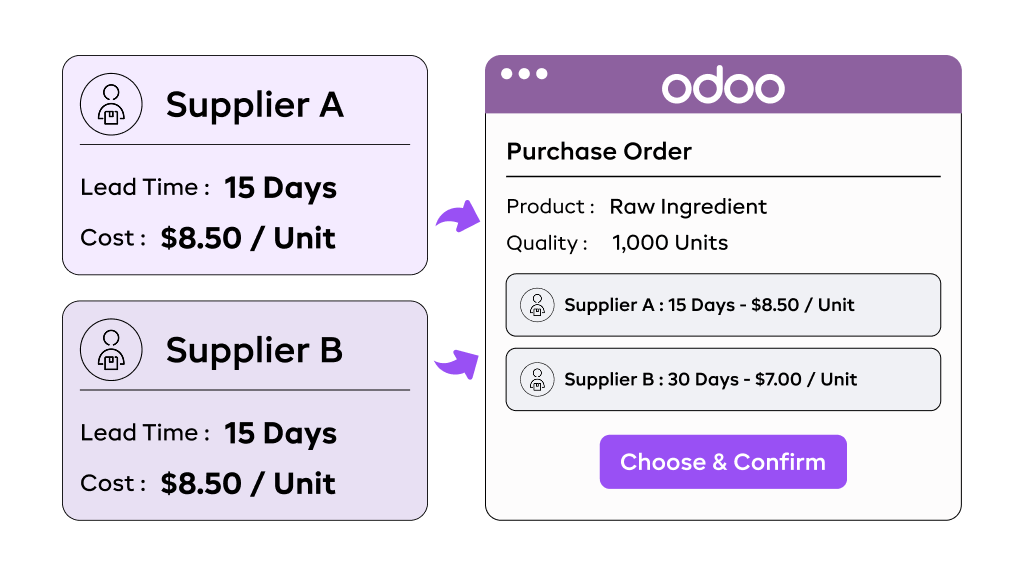
Many companies keep two or three suppliers for the same ingredient. One may offer a better price, another may be more reliable, and a third may be kept as a backup for emergencies. When this is managed through emails or details are stored limited to a person, it becomes hard to remember the actual price, who can deliver the fastest, and which supplier is actually performing well.Lead times and seasonal items that keep changing
Imported spices, seasonal fruits, or specialty ingredients rarely follow a predictable pattern. Some containers arrive earlier than promised, while others are delayed. If you plan production based on assumptions rather than real purchase and stock data, you risk either stopping production or carrying too much safety stock.How Odoo helps in such situations
In Odoo, every supplier sits in one place along with prices, lead times, and past performance. Reordering rules combine this information with real-time stock and open orders.For example, a juice manufacturer can see that mango pulp from Supplier A has a longer lead time but fewer quality issues, while Supplier B is faster but more expensive. The planner can decide based on facts, not guesswork, and Odoo suggests purchase orders that reflect those choices.
Uncanny insight
In our projects, we usually begin by cleaning supplier and product data before switching on automatic reordering. This gives planners confidence that when Odoo suggests a purchase, it is based on information they trust rather than legacy records. For a deeper dive, read our post on how Odoo improves supply-chain management for F&B.
Compliance and food safety that you must adhere to
In food safety, it’s not enough to just follow the rules. You must be able to prove the safety of your food.
When something goes wrong, handwritten logs, spreadsheets, and scattered documents cannot protect you. Only clear, reliable records can.
Meeting traceability expectations in real life
Large retailers, export customers, and regulators expect clear traceability. They want to know which farm or supplier the ingredient came from, which production batch used it, and which customers received that batch. If this information is spread across delivery notes, emails, and Excel sheets, answering even simple questions can take days.Handling audits and recalls without panic
In a real incident, you often have only a few hours to act. If you can’t trace which lots are affected, you either recall far more than necessary or risk leaving the wrong products in the market. Both outcomes are costly, and both put your reputation at risk. What you need is instant, accurate traceability so your decisions are based on facts.How Odoo helps in such situations
With Odoo, lots and batches are registered as soon as goods arrive. When a batch of tomato puree is used in production, Odoo records which finished products it went into. If later you learn that a specific lot from a supplier has an issue, you can pull a report that shows exactly which finished batches used that lot and where they were shipped. During audits, you can walk through the full chain instead of searching through files.Uncanny insight
At Uncanny, we set up Odoo for food clients, and pay special attention to how lots are created and used in day-to-day workflows. The goal is to make traceability automatic as people do their normal work instead of adding extra manual steps that staff will eventually skip.
Perishable stock that make daily plannning a challenge
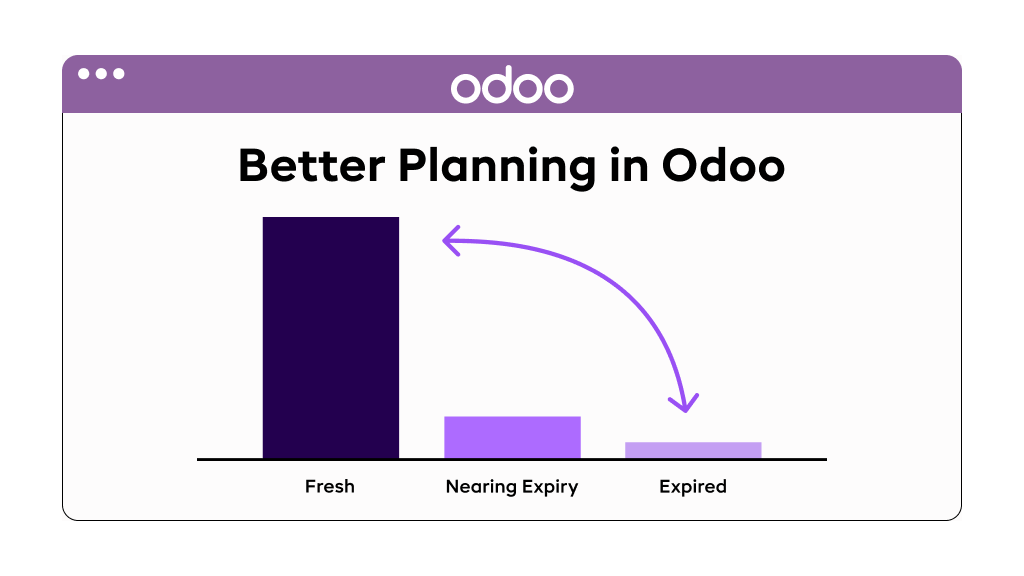
In this industry, products don’t stay fresh forever. They move toward expiry every hour. One miscalculated purchase can lead to stockouts, wastage, or unnecessary discounts. Precision in planning isn’t optional; it’s survival.
Overstocking that quietly eats your margin
When teams fear running out of stock, they often overorder to be safe. For perishable items such as fresh dairy, leafy vegetables, or short-life bakery ingredients, this can lead to regular write-offs. The cost may look small daily, but it adds up to a significant margin leak over a year.Understocking that hurts sales and relationships
On the other hand, buying too little or too late can stop a production run or force you to remove a product from the menu. Retail customers see empty shelves, restaurants do not receive their usual orders, and you may have to offer discounts or urgent air freight to recover. This affects both revenue and trust.How Odoo helps in such situations
Odoo allows you to record expiry dates for each lot and use FEFO, so the system suggests picking the items that will expire first. A central kitchen can see which vacuum-packed items must be used within the next two days and adjust production accordingly.Alerts help purchasing teams notice when certain ingredients need to be consumed or discounted before they are lost. Over time, you can compare planned with actual waste and adjust ordering rules based on real behaviour, not rough estimates.
To understand it with a real-world application, see how NAH Foods used Odoo for a 95% efficiency gain.
Quality and consistency that protect your brand
Customers may forgive a late delivery once, but they rarely forget a bad product experience. Consistent taste, appearance, and safety are what keep them coming back.
Quality checks that sit outside your main systems
Many teams still use clipboards or separate spreadsheets to record quality checks at goods receipt and during production. These records are easy to misplace and hard to analyze. When a customer complaint arrives, tracing the relevant checks takes a lot of manual digging.Recurring issues that stay hidden for too long
If quality data is not structured, it is difficult to notice patterns. You might not realize that most recurring issues come from one supplier, or that a particular issue is leading to most packaging faults. Without this insight, teams end up treating symptoms rather than causes.How Odoo helps in such situations
With Odoo, quality checks are triggered as part of the workflow. For example, every incoming batch of milk can automatically create a quality check task that requires specific measurements, such as temperature and acidity, before the lot can be moved to usable stock.If there is a recurring problem with one supplier, you can see a history of non-conformities linked to that supplier and that ingredient. A snack manufacturer can use these reports in supplier reviews to improve internal procedures.
Recipes and batches that keep evolving
Recipes in food and beverage are living documents. They change as you refine your product, respond to raw material changes, or adjust to cost pressures.
Recipes that change as your product improves
Over time, you might reduce sugar content, replace an imported spice with a local alternative, or change a cooking step to improve texture. If these changes are not controlled, different teams may follow different versions of the same recipe, leading to inconsistent taste results.Batch sizes and yields that do not stay fixed
A test batch behaves very differently from full-scale production. Yield losses shift with raw material quality, cooking processes, trimming, and even the equipment used. If you don’t capture actual yields in a structured way, planners end up working on assumptions. That leads to wrong cost calculations and inaccurate material planning, which ripple across the entire operation.How Odoo helps in such situations
In Odoo Manufacturing, each finished product has a Bill of Materials (BoM) that represents the current approved recipe. When you change a recipe, you create a new version rather than overwrite the old one.For example, a sauce manufacturer can keep a history of recipes as they reduce salt or change herbs, while ensuring that production teams always see the latest approved version. Work orders allow operators to record actual output, so you can compare expected and real yields for each product and adjust planning or pricing based on evidence.
Multi-channel and multi-site sales that need a single view
Most modern food and beverage brands do not rely on a single channel for sales. They sell to B2B customers, run their own outlets, and sometimes sell direct to consumers online. Without a unified system, each channel becomes isolated.
B2B relationships with distributors and retailers
When you sell to distributors, supermarket chains, or hotel groups, you deal with volume-based pricing, promotional commitments, and credit limits. If these details live in separate files per salesperson, it is easy to make promises the operation team cannot fulfil or offer pricing that reduces margin.Direct sales through outlets and online channels
Cafe, brand stores, cloud kitchens, and ecommerce sites all need accurate stock and pricing. If your outlet POS, online store, and central inventory are not linked, you risk selling the same stock twice or disappointing customers with cancelled orders.How Odoo helps in such situations
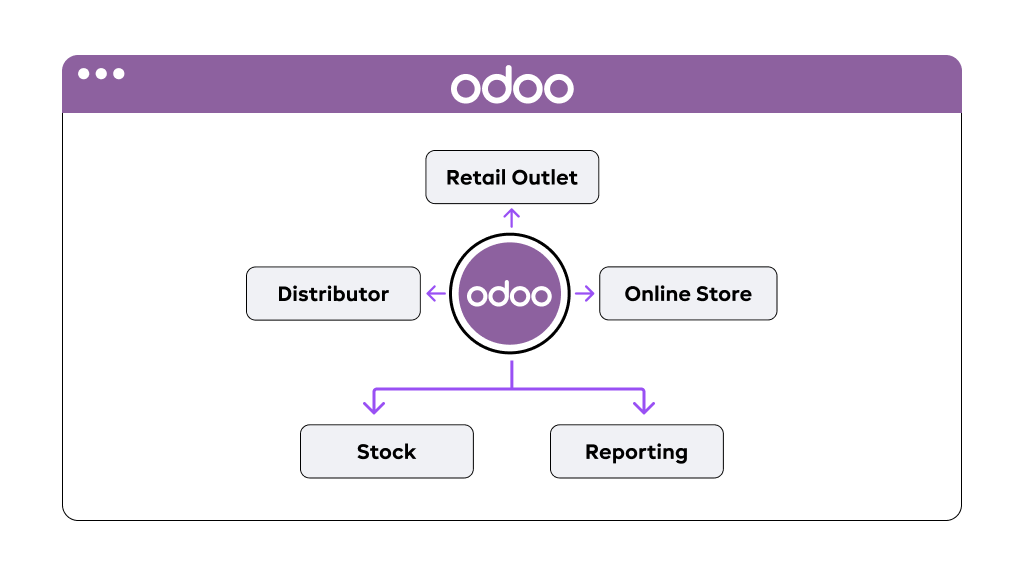
Odoo connects every sales channel,POS and web app to a common inventory and accounting base. A brand that sells bottled cold brew coffee can see wholesale orders from retailers, retail sales through its own cafe, and online orders from the website in one dashboard.Stock reserves reflect confirmed orders across all channels, so planners know the real demand picture. This also makes it easier to compare profitability by channel and decide where to focus marketing and capacity.
Want to start a project with us?
Empowering businesses to achieve greatness through strategic guidance and innovative solutions.
Book A Demo
The Odoo Apps That Usually Matter Most In Food And Beverage
How the Odoo Inventory app becomes your base for stock and lots
Inventory is usually where your Odoo journey starts. If your stock is not right nothing else feels stable.
Real-time stock visibility
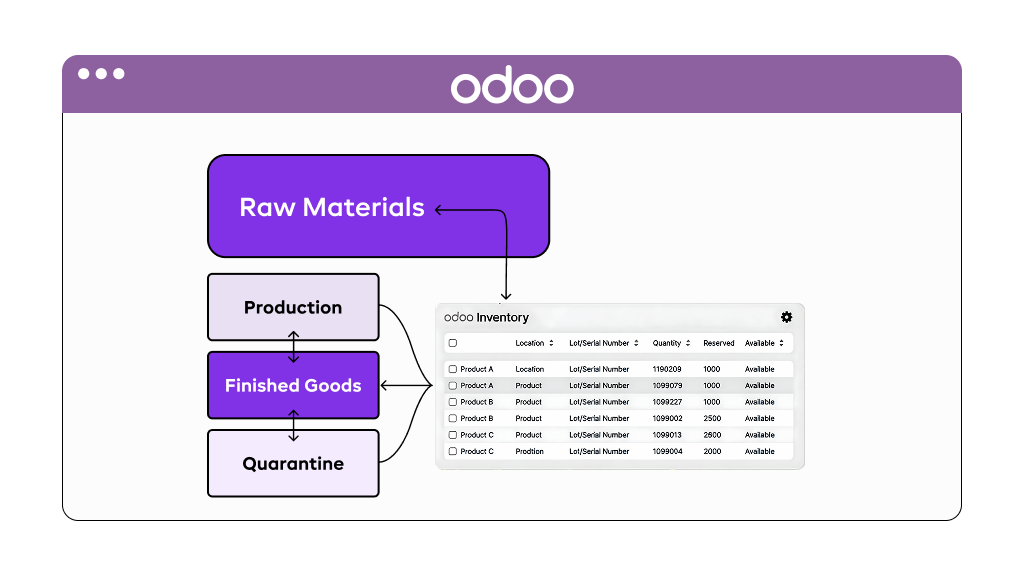
You can see how much you have by product lot and location across warehouses outlets and internal areas such as in transit quarantine or quality hold. This helps you plan production and deliveries without walking the floor or calling each warehouse.Lot and expiry tracking without extra spreadsheets
Lots are created or recorded when you receive goods and they stay with the product through production and shipping. Expiry dates are captured and can be used when you pick stock so the system nudges you to move the items that should go out first.Barcode and scanner friendly work
Your warehouse and production teams can use barcode scanners for receiving internal moves and picking. This reduces keying errors and makes day to day work faster which matters in cold rooms and busy docks.Uncanny note
We normally start by fixing product units and locations before going live with Inventory. Once your basic data is clean people start trusting what they see on screen and you can confidently move to more advanced features such as automatic reordering.
How the Odoo Manufacturing app mirrors your real production
If you cook, blend, brew, bake, or pack anything at scale, Manufacturing is where your recipes and processes become real digital flows.
Bills of Materials that act as living recipes
Each finished product can have a recipe that lists every ingredient quantity and by-product. You can keep this simple for basic products or very detailed for complex formulations. This connects raw materials directly to finished items so you always know what went where.Work orders that follow the way your team actually works
You can break production into steps such as preparation, mixing, cooking, cooling, and packing. Operators see these steps as work orders, record when they start and finish, and log any issues. This turns informal knowledge on the floor into structured information you can learn from.Comparing planned and actual performance
Odoo lets you capture actual material consumption and time spent per batch. When you compare this with what you planned, you can see where yields are lower or certain steps always take longer. That insight helps you adjust recipe instructions or staffing instead of assuming everything is on target.Uncanny note
When we configure manufacturing, we usually run a few pilot batches with your team inside Odoo. This lets operators tell us what feels natural and what does not, so the final setup reflects your real process rather than a textbook flow.
How the Odoo Quality app brings checks into your normal flow
Quality is most useful when it is part of your daily work, not an extra layer that people forget when things get busy.
Control points where they actually matter
You can decide that certain products or suppliers always require checks at goods receipt, and that specific production operations have their own in-process checks. Odoo then creates tasks automatically so people do not have to remember what to check and when.Flexible ways to record checks
A check can be a simple yes or no question, a numeric measurement, or a short form. For example, you might record temperature at receipt, visual checks during trimming, and seal integrity after packing, all in a way that suits each product.Using data to improve instead of just to file reports
Because every check is stored in the same system that holds your lots, suppliers, and work orders, you can see patterns over time. You might notice that one supplier fails temperature checks more often or that a particular line produces more packaging issues, which gives you a clear starting point for improvement.How the Odoo Point of Sale app supports your outlets and tasting rooms
If you run cafés, shops, kiosks, or a taproom, your front-of-house needs to communicate with your back office without manual steps.
Simple screens for busy staff
The POS app is touch-friendly and supports product images and straightforward buttons. New staff can usually learn the basics in a short session, which helps during seasonal peaks or high turnover.Stock and accounting that stay in sync
Every sale through POS updates your stock and creates the accounting entries in the background. You do not need to export files at the end of the day and upload them somewhere else, which reduces end-of-shift stress and errors.Staying open even when the network has issues
POS can keep working if the internet drops and then sync with your main Odoo database once the connection returns. Your team keeps serving customers, and stock and financial data catch up automatically.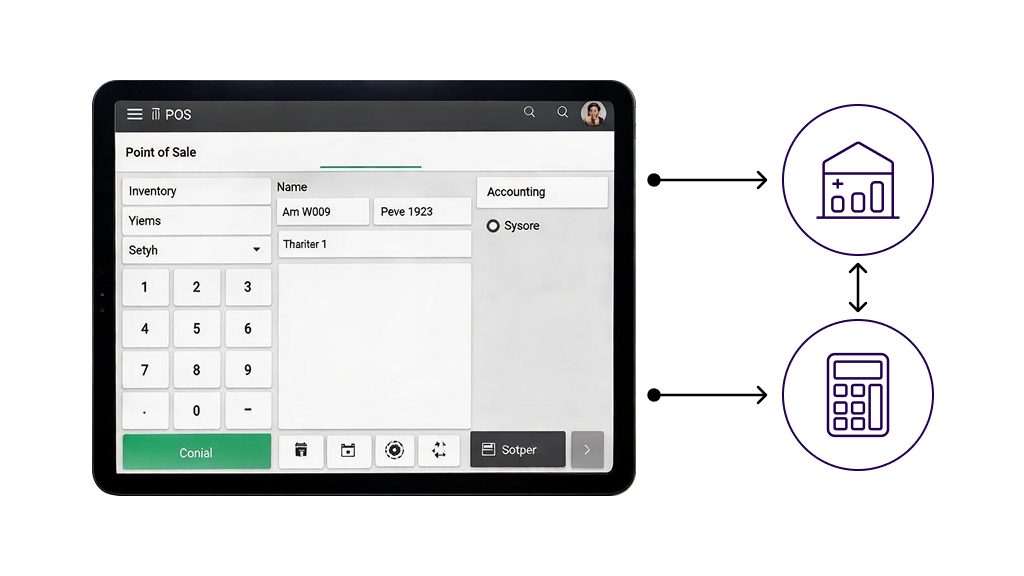
How the Odoo Sales and CRM apps support your B2B relationships
If you sell to retailers, hotels, restaurants, distributors, or other businesses, you need a structure around deal pricing and follow-up.
Keeping track of leads and opportunities
You can register new prospects, log calls, meetings, and samples, and see where each opportunity stands. This helps you and your sales team follow up at the right time instead of relying on memory or scattered notes.Quotes and agreements that flow straight into orders
Your team can prepare quotes with the right price lists and conditions and send them directly from Odoo. When a customer confirms, you can convert that quote into a sales order without retyping, which saves time and avoids mistakes.Understanding which customers and products drive your profit
Because Sales is linked with Inventory and Accounting, you can analyse sales and margin by customer, by region, and by product. This makes it easier to decide who should get more attention and which products need a different pricing or promotion strategy.How the Odoo Accounting app stays close to your real operations
Accounting in Odoo is not a separate island. It shares the same data your operations team uses which makes your numbers more trustworthy.
Automatic entries from day-to-day work
Customer invoices, vendor bills, and stock movements all generate accounting entries without extra typing. Your finance team spends less time entering data and more time checking and explaining results.Support for multiple entities and tax settings
If you have several legal entities or work with more than one tax regime, Odoo can handle that in a structured way. This is useful when you operate factories and sales companies in different regions or work both locally and for export.Financial reports that reflect what is happening now
Because Accounting pulls directly from live sales, purchase, and stock data, you can open profit and loss balance sheet and cash flow views that are much closer to real time. This helps you make faster decisions on spending, pricing, and investment.How the Odoo HR and payroll apps support complex staffing patterns
Food and beverage businesses often rely on shifts, weekend work, and seasonal hiring, so people data needs to be organised and accurate.
One place for employee information
You can keep contracts, roles, contact details, and important documents together for every employee, whether they work in production warehouses, sales outlets, or offices. This helps HR and managers stay aligned when staff move sites or change roles.Attendance and shift planning that match your operations
Odoo can track check-in and check-out times and handle shift schedules. This is useful when you run multiple lines or outlets and need to balance coverage while controlling overtime.Payroll that reflects actual hours and rules
When set up correctly, Odoo can use attendance data to help calculate payroll, including overtime and allowances. This reduces manual adjustments and disputes about hours and pay.How the Odoo Purchase app strengthens your work with suppliers
Purchase is where you turn your material needs into structured supplier orders and long-term relationships instead of last-minute calls.
Clear view of who supplies what and on what terms
For each ingredient or material, you can see approved suppliers' usual lead times, prices, and minimum order quantities. This lets buyers make decisions based on up-to-date information rather than old email threads.Approvals that protect your spend
You can require approvals for orders above certain values or for specific categories, such as new packaging or equipment. This helps control costs and ensures sensitive purchases are reviewed before money is committed.Supplier performance that you can actually measure
Over time, Odoo can show you which suppliers usually deliver on time, which tend to be late, and where quality issues start. That information is useful when you negotiate renewals or consider adding or removing suppliers from your list.Uncanny insight
We help clients set up simple supplier scorecards in Odoo, so your reviews are based on data such as delivery timeliness and quality results rather than impressions alone.
How the Odoo Marketing Automation app keeps you in touch with customers
If you sell direct or manage important customer portfolios, you need a consistent way to stay visible and relevant.
Segmenting customers in a meaningful way
You can group customers by location, purchase pattern, channel, or product interest. This lets you send focused messages, such as a new flavour launch to people who bought similar products before.Setting up useful automated journeys
You can create simple flows such as welcome messages for new wholesale customers, follow-up emails after first orders, or reminders when a product is likely to be finished at the customer's site. Once these are configured, Odoo runs them for you, and your team only needs to refine the content over time.Seeing what actually works in your communication
Odoo shows open rates, clicks and responses for each campaign. You can see which messages bring people back to order again and which do not move the needle and adjust your approach accordingly.Found this post helpful? Be sure to share it with your network!


About Author
Sanjay Gohel is the Head of Department – Odoo at UNCANNY Consulting Services, specializing in ERP implementation, Odoo development, and software solutions. He helps businesses improve efficiency through customized ERP systems designed to streamline workflows and support operational excellence.


Sanjay Gohel is the Head of Department – Odoo at UNCANNY Consulting Services, specializing in ERP implementation, Odoo development, and software solutions. He helps businesses improve efficiency through customized ERP systems designed to streamline workflows and support operational excellence.