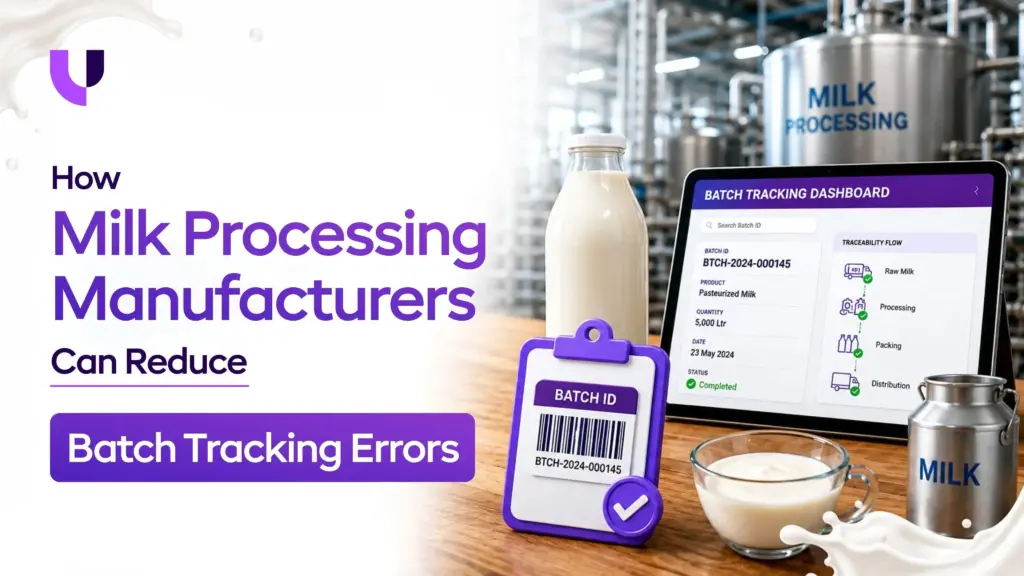
How Milk Processing Manufacturers Can Reduce Batch Tracking Errors
Published on June 24th 2026
Overview
Milk production operations involve a significant volume of inputs and team members; missing a single data set could halt the entire operation. This blog takes a closer look at how a reliable dairy ERP can turn such problems into efficiency with real-time batch tracking.
Introduction
Most dairy manufacturers are unaware of batch tracking problems during production. They generally discover it at a later stage.
Batch tracking becomes most obvious when:
- A customer complaint needs investigation.
- An auditor requests records.
- A product recall requires teams to trace a batch back through the production process.
That is when missing, inaccurate, or inconsistent data starts creating problems.
For dairy manufacturers, the problem is even greater. The difference between production and successful batch tracking only tends to increase as they scale.
Research by GS1 shows that poor-quality traceability data remains one of the biggest challenges in food manufacturing, as incomplete records directly affect recall management and compliance efforts.
This is a major reason why the majority of milk processing manufacturers are moving towards dairy ERP to reduce batch-tracking errors, improve inventory management, and gain visibility.
9 Ways Milk Processing Manufacturers Can Reduce Batch Tracking Errors and Improve Traceability
Batch tracking errors rarely originate from a single unit in your workflow. Here’s a closer look at 9 ways milk processing manufacturers can reduce batch tracking errors:
1. Replace Manual Batch Recording With Automated Data Capture
Batch tracking errors rarely start with a major mistake. Most of the time, they’re a result of small gaps in everyday recordkeeping:
- A production operator manually updates a batch number.
- A quality check is recorded later in the shift.
- Packaging information is entered into a spreadsheet, while production data is stored elsewhere.
None of these issues seems to cause friction when they start. The problem starts weeks later when teams try to trace a product back to its origin, production history, or batch. It’s mostly during this time that team members identify missing, duplicate, or inconsistent information.
How can manufacturers reduce the risk?
Start by identifying every point where batch information is currently recorded manually. In most milk processing facilities, this includes raw milk receipts, quality inspections, production activities, packaging operations, inventory transfers, and dispatch records.
Replace paper-based logs and spreadsheet tracking with digital workflows that capture information automatically as transactions occur. Milk processing ERP software can record batch numbers, lot references, timestamps, operator details, inventory movements, and quality results directly within the system.
Capturing information at key HACCP checkpoints also helps ensure production records remain accurate and traceable throughout the manufacturing process.
What changes after the milk processing ERP?
Instead of building traceability records after production is complete, the information is captured as production happens. That alone eliminates many of the gaps that cause batch-tracking errors in the first place.
2. Create a Single Source of Truth for Batch Information
Batch information tends to spread throughout a dairy plant:
- Milk receipt records may be held by procurement.
- Production data may be tracked separately.
- Quality teams often maintain their own records, while inventory and dispatch information is stored elsewhere.
At first, this does not seem like a problem. However, things begin to change when someone needs to investigate a batch. Different teams produce different versions of the same information.
This indicates a clear problem: the more systems involved, the harder it becomes to determine which record is correct.
How can manufacturers reduce the risk?
Begin by reviewing where batch information is currently stored across procurement, production, quality control, inventory, and dispatch operations. In many dairy plants, traceability records are spread across spreadsheets, paper documents, laboratory reports, and separate software systems.
Consolidating these records into a centralized dairy ERP platform creates a single batch history accessible to all departments. This includes production records, inventory transactions, quality documentation, food safety records, and dispatch information.
Remember, maintaining one version of the data also supports audit readiness and reduces inconsistencies during investigations or recalls.
What changes after the milk processing ERP?
When questions arise, everyone is looking at the same batch record. With dairy ERP software, teams gain an edge when investigating daily operations. Need answers around a specific batch? The answer is available in a few clicks. Having a single source of truth simplifies the reconciliation of conflicting information.
3. Establish End-to-End Traceability From Raw Milk to Finished Products
Most milk manufacturers can identify a finished product batch. The real test is whether they can trace everything connected to it.
If any issue with product quality is raised, teams may need to trace a specific batch back to its source. They may also need to identify the ingredients used in production or perform quality checks during production. One missing piece of information here can make the investigation more challenging.
Scaling manufacturers often face the hassle of losing data as their businesses grow.
How can manufacturers reduce the risk?
Create traceability links between raw milk receipts, ingredient lots, production batches, and quality records, among other units in the production line. Every stage should remain connected so manufacturers can follow a product's journey from intake through dispatch.
Modern dairy ERP software supports lot traceability and batch genealogy by automatically linking these records together. This makes it easier to trace products such as pasteurized milk, UHT milk, yogurt, and cheese back to specific milk lots, production activities, and quality checks during audits, customer complaints, or recall investigations.
What changes after the milk processing ERP?
Instead of piecing information together from multiple records, teams can follow a batch through its entire journey. That visibility makes recalls, audits, and quality investigations far easier to manage when time matters most.
4. Track Batch Movements in Real Time Across Processing Stages
A batch of milk does not move through production in a straight line.
It can go from a storage silo to processing, to a holding tank, to packaging before it eventually gets to dispatch. On a busy production day, several batches may be moving through the plant at the same time.
That is usually where traceability starts becoming difficult.
If a transfer is not recorded properly or a batch is updated late, teams may lose visibility into where that batch was processed, stored, or packaged. Finding that information later can take far longer than it should.
How can manufacturers reduce the risk?
Take a batch of milk through a typical day of production and you will soon realize how many times it moves.
Milk can move from a receiving silo to a processing line, then to holding tanks, to packaging, to cold storage, and finally to a finished goods warehouse. With every transfer, there is a further opportunity for traceability information to be missed or recorded late.
Record these movements as they happen and do not update them manually. Dairy manufacturing software can automatically record transfers between silos, tanks, processing lines, and storage locations so the batch history is linked from intake to dispatch.
What changes after the milk processing ERP?<br
Instead of searching through production records, teams can see exactly where a batch has been and where it is currently located.
5. Standardize Batch Tracking Procedures Across Teams and Production Lines
Batch tracking usually involves more people than most manufacturers realize. Here’s a closer look at the involvement:
- Production teams record processing activities.
- Quality teams capture inspections and test results.
- Warehouse teams update inventory movements.
- Dispatch teams record outgoing shipments.
When every department uses its own method for recording information, data becomes inconsistent.
A naming difference here, a missing field there, may not seem like much at the time, but those little gaps are hard to ignore when someone has to trace a product through production. This becomes more common as new production lines, products, and teams are added.
How can manufacturers reduce the risk?
In many dairy facilities, production lines follow slightly different documentation practices.
One team may record complete batch details, while another captures only the information needed for production. Quality teams may use a different format for recording inspections, and warehouse teams may maintain their own inventory references. Over time, these small differences create inconsistencies in traceability records.
Establishing standardized operating procedures (SOPs) helps ensure that batch information is recorded consistently across production, quality, inventory, packaging, and dispatch activities.
Aligning these procedures with HACCP documentation requirements also creates more consistent records for audits, investigations, and recall readiness.
What changes after the milk processing ERP?
Records remain more consistent from one stage of production to the next, making batch histories easier to follow and verify.
6. Connect Quality Control Records Directly to Batch Histories
Most quality investigations start with a simple question: What happened to this batch?
The answer is not always easy to find.
The production records may show the date the batch was processed. Laboratory reports might be in another system. Inspection results, approvals, and corrective actions can be stored elsewhere.
It’s there, but it’s all over the place.
Teams, in turn, spend time gathering records before they can even begin to understand the problem itself. Delays can get frustrating fast when you’re involved in an audit, customer complaint, or product recall.
How can manufacturers reduce the risk?
When a quality issue is discovered, the first step is usually finding the records linked to the affected batch.
That becomes difficult when laboratory reports, inspection records, approvals, and corrective actions are stored separately from production information. Teams often end up moving between different files, spreadsheets, or systems before they can understand what happened during production.
Connecting quality records directly to batch histories solves this problem. Dairy ERP software can automatically associate microbiological testing results, critical control point (CCP) records, quality inspections, and corrective actions with the batches they relate to, creating a more complete and searchable traceability record.
What changes after the milk processing ERP?
When a batch needs review, the supporting quality records are already connected to it, making investigations faster and traceability information easier to verify.
7. Use Barcode or QR Code-Based Batch Identification
Batch numbers are only useful if they are written down correctly.
In many plants, teams continue to record key batch information, such as raw materials, inventory, and production activities, manually.
For most businesses, this process seems to work until there’s some discrepancy in data entry:
- A label may be missed
- A wrong batch could contain incorrect information
- A wrong batch could be tied to a product.
Often, these mistakes are small enough that they go unnoticed until someone tries to trace a batch later. That can then take longer to track down the cause of the error than expected.
How can manufacturers reduce the risk?
Batch identification errors often begin with something simple: a number entered incorrectly or a label attached to the wrong product.
As production volumes increase, manually recording batch information becomes more difficult to manage consistently.
A small error made during receiving, packaging, storage, or dispatch can later affect traceability investigations. Using barcode or QR code labels allows operators to scan products rather than enter batch information manually.
Applying these labels to milk lots, packaging materials, work-in-progress inventory, and finished dairy products helps improve lot traceability while reducing identification errors throughout the production process.
What changes after the milk processing ERP?
Batch information is captured more consistently, reducing identification errors and making products easier to trace throughout the production process.
8. Set Up Automated Validation and Error Alerts
A batch tracking error is much easier to fix on the day it happens than three weeks later during an audit.
The problem is that many errors do not announce themselves.
A batch record may be incomplete. A required field may be left blank. The same batch could be entered twice, or information recorded during production may not match information recorded elsewhere. These issues often sit unnoticed until someone needs the records for a traceability check or investigation.
By then, correcting the information becomes far more difficult.
How can manufacturers reduce the risk?
Review the most common batch tracking issues occurring within the facility, such as missing batch numbers, duplicate records, incomplete production data, or inconsistencies between inventory and quality records.
These issues should be converted into validation rules that automatically check data accuracy as information is entered into the system. Milk processing ERP software can monitor traceability records in real time and generate alerts whenever required information is missing or conflicts with existing records.
Automated validation rules help identify these issues much earlier. Milk processing ERP software can flag missing batch numbers, duplicate records, incomplete production information, or inconsistencies between quality and inventory data. This supports stronger traceability practices and helps manufacturers meet FSMA and food safety documentation requirements
What changes after the milk processing ERP?
Errors are identified much earlier in the process, reducing the risk of incomplete records that could affect traceability, compliance activities, or product investigations.
9. Maintain Digital Audit Trails for Every Batch Transaction
One of the most common questions you will hear during an audit is not what happened but when it happened and who made the change.
Answering these questions can be challenging, especially when you are dealing with disconnected systems, manual data entry, or spreadsheets. You might have old records, approvals that were never transferred, or missing records.
That adds unnecessary uncertainty when manufacturers need to review batch histories, investigate quality issues, or demonstrate compliance.
How can manufacturers reduce the risk?
During an audit or investigation, manufacturers are often asked questions that go beyond the batch itself.
- Who updated the record?
- When was the change made?
- Was the batch approved before dispatch?
Without a complete history, answering these questions can take considerable time.
Maintaining digital audit trails creates a permanent record of production activities, inventory transactions, quality approvals, modifications, and dispatch events. Having this information available in one place helps support regulatory inspections, recall investigations, and compliance reviews while making traceability records easier to verify.
What changes after the milk processing ERP?
Teams gain a clear record of batch-related activities, making audits easier to manage while improving confidence in the accuracy and completeness of traceability data.
How Uncanny Helps Dairy Makers Improve Batch Traceability

"
A Unified Platform for Milk Procurement, Production, Quality, & Inventory
Usually, batch information is spread out across different teams. Milk procurement data may be in one system, production data in another, and quality or inventory data in yet another.
The issue seems to arise when one needs to track a product in a hurry. Rather than tracking one record, teams end up gathering data from multiple sources before they even know what happened.
Uncanny CS integrates these activities into a single system, enabling teams to work from the same operational information throughout the production cycle.
By Providing End-to-End Batch and Lot Traceability Across Operations
It is much easier to trace things when each stage in the production process is connected.
Uncanny keeps a complete record of all batch activity, from receipt of milk and use of ingredients to production batches, quality checks, inventory transactions, and finished products. This simplifies product tracking throughout the product lifecycle and eliminates the need for disparate records.
By Giving Real-Time Visibility Into Batch Status and Product Movement
Batch info changes during the day. Products go from tank to processing line, to storage, to packaging, and finally to dispatch. Without a clear vision, it can take a lot of time to find the latest batch information.
Uncanny gives teams a real-time view of batch status and product movement, so they can get the information they need when they need it, not look for it later.
Automating Batch Tracking and Documentation Processes
Much of traceability is contingent on the quality of the records kept. Human data entry is error-prone, and information is missing.
Uncanny automates batch tracking and documentation at every step of the production process, reducing manual effort and ensuring more consistent, traceable records.
Improving Batch Traceability With the Right Dairy ERP Software
Most traceability problems are not due to a lack of information. Dairy manufacturers already produce large volumes of data throughout their workflows.
The challenge is to keep that information accurate, linked, and accessible when it is needed. That is why automation, standardized processes, and end-to-end visibility play such an important role in batch traceability.
Milk processing ERP software and dairy manufacturing software help integrate these activities into a single system.
For dairy businesses looking to build more reliable and scalable traceability processes, UncannyCS provides the operational visibility and control needed to support long-term growth and reduce the risk of batch-tracking errors.
Ready to reform your milk production business? Seize the opportunity to discuss your setbacks with our team at the Odoo Experience 2026 in Belgium between September 24–26, 2026. Book your slots today!
Want to start a project with us?
Empowering businesses to achieve greatness through strategic guidance and innovative solutions.
Book A Demo
FAQs
Q. What are the most common causes of batch tracking errors in dairy manufacturing?
Most batch-tracking errors in dairy manufacturing result from everyday processes such as manual data entry, inconsistent documentation, and incomplete records. These issues may not appear significant, but they add resistance to the workflow as the business expands.
Q. How does milk processing ERP software improve batch traceability?
A reliable milk process ERP connects the entire workflow, from procurement to inventory. It brings data into a single connected system, where teams share a single data source for operations.
Q. Why is end-to-end traceability important in milk processing plants?
End-to-end traceability plays a key role in milk processing plants. It allows teams to trace a batch back to its source, identify the ingredients used, and analyze errors to resolve complaints, initiate batch recalls, and address other issues.
Q. How can dairy manufacturers reduce manual batch tracking processes?
Manufacturers can adopt an ERP system that tracks everything from procurement to delivery.
Q. What role do barcode and QR code systems play in batch management?
Barcode and QR code systems replace manual efforts and simplify batch identification for business owners.
Q. How does dairy ERP software support product recall management?
Dairy ERP keeps a record of everything, from expiry dates to ingredients used and more. It helps teams track down exact key information in case a batch is recalled.
Q. What information should be included in a dairy batch tracking record?
A dairy batch tracking record should include everything from milk receipt information to quality test results. The goal of batch tracking should be to cover the entire process, from product production to delivery.
Q. How can dairy manufacturing software improve compliance and audit readiness?
Replacing manual entries with a reliable dairy ERP can help manufacturers improve software compliance and audit readiness. An ERP stores all the crucial information in a centralized database, allowing businesses to retrieve it as needed.
About Author