Why Clutch Recognizes Uncanny as the Top eCommerce Development Company in India?
Published on July 22nd 2026

What Does Clutch Recognition Actually Mean When Choosing an eCommerce Partner?
Clutch recognition can be a great benchmark when comparing different development companies. However, it shouldn’t be the basis for your hiring decisions.
What matters is the team:
- Do they understand your business model?
- Do they think in terms of integrations?
- Do they accommodate evolving requirements?
- Do they support the platform after go-live?
These things matter even more if an eCommerce store relies on ERP, CRM, inventory, payment, or other business systems.
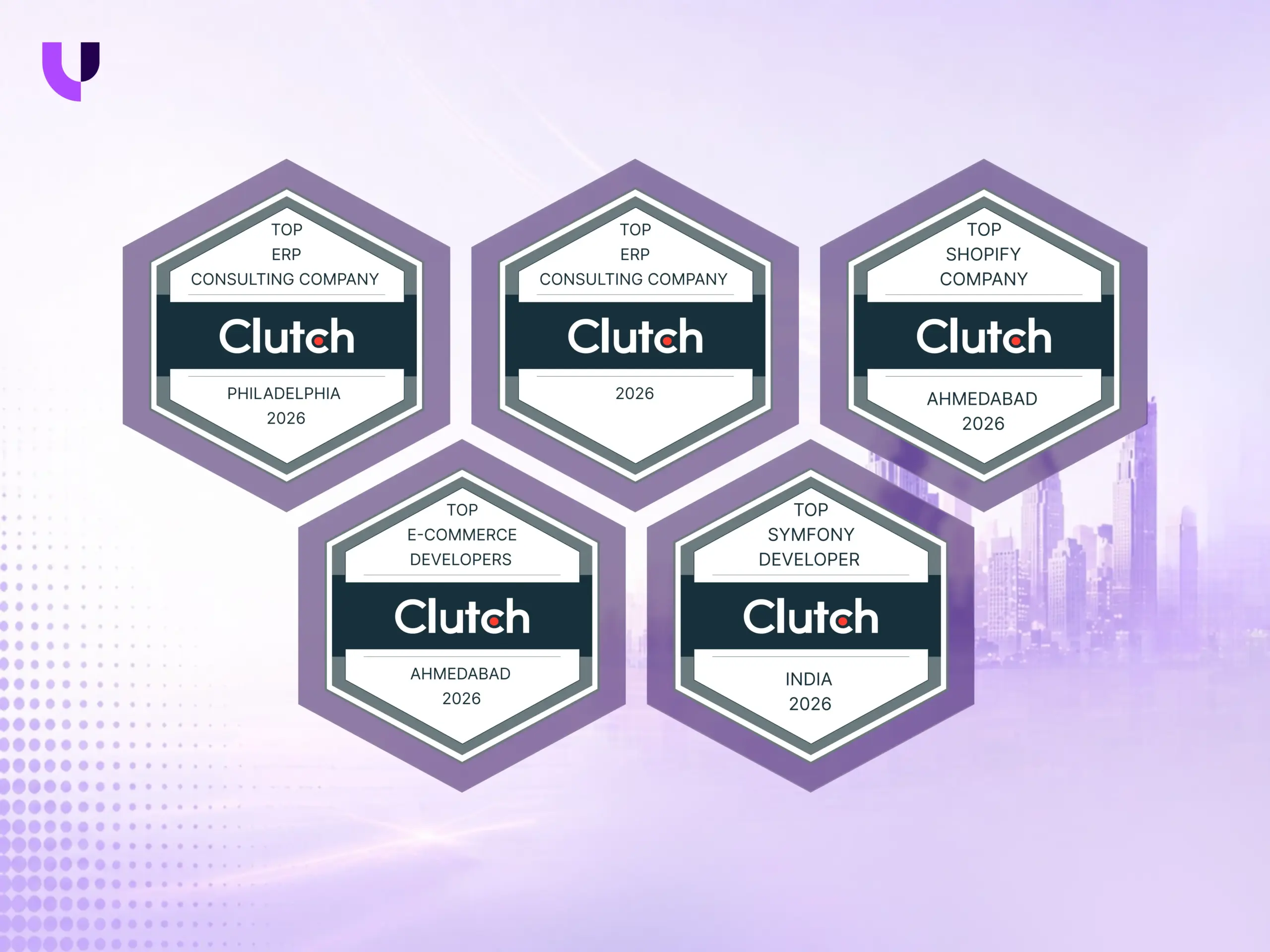
That is why Uncanny’s 2026 recognition across eCommerce development, Shopify, ERP consulting, and Symfony development is worth viewing together.
The recognition builds confidence, but the capabilities behind it are what businesses should examine before choosing a partner.
5 Capabilities Behind Uncanny’s Recognition as a Top eCommerce Development Company
Recognition may help a company get onto a shortlist. What matters more is whether the team can make sound decisions as the project scales.
At UncannyCS, we’re focused on how businesses sell, how systems exchange data, or how they plan to scale in the future. Here are five core capabilities behind Uncanny’s recognition as a top eCommerce development company.
1. Starting With the Business Model Before Choosing the Technology
Two businesses can both say they need an eCommerce platform and mean completely different things.
One may sell directly to consumers at standard prices and with a relatively small catalog. Another may need separate prices for distributors, account approvals, bulk ordering, credit terms, or different product ranges for different customers. Add multiple markets or stores that share the same inventory, and the gap widens further.
This is where choosing technology too early can cause trouble. A platform may look right during the initial build, only for the team to discover later that an important pricing rule needs a workaround, or that a routine order process requires custom development whenever it changes.
How Uncanny approaches it
Uncanny looks at those working details before treating the platform as a settled decision.
- How are products priced?
- Who can place an order?
- Where does inventory come from?
- What happens after checkout?
- Which existing systems need the same information?
The answers give the project a much firmer starting point. Technology is then evaluated against how the business already sells, the processes it needs to support, and the changes it expects as it grows.
Practical outcome
The business starts with fewer forced workarounds and a commerce setup that is less likely to become restrictive as products, channels, or customer requirements change.
2. Connecting eCommerce With the Systems That Run the Business
An order placed online rarely stays inside the eCommerce platform.
Inventory may need to update in an ERP. Customer details may flow into a CRM. Payment information has to reconcile correctly. The warehouse needs the right order data, while a 3PL or shipping provider may be waiting for fulfillment instructions.
When these connections are weak, teams usually fill the gaps themselves. Someone exports a spreadsheet. Another person corrects inventory manually. Finance reconciles records that should already agree. Customers may only notice the problem when stock availability or order status is incorrect.
How Uncanny approaches it
Uncanny brings eCommerce development and ERP consulting capability into the same conversation. The team looks at which data needs to move, which system should own it, when synchronization should occur, and what should happen when an integration fails.
That matters because connecting systems is not simply about making two APIs exchange data. The flow has to make sense for the operation behind the store.
Practical outcome
Orders, inventory, customer data, and operational records move with less manual intervention, giving teams fewer gaps to reconcile as transaction volumes increase.
3. Handling Custom Requirements Without Making the Platform Fragile
Custom work is not unusual in eCommerce. The trouble starts when every new requirement is solved by adding another patch.
A B2B customer needs a different approval flow. The checkout needs to behave differently for one market. A third-party service has no ready-made connector. Six months later, the business wants to upgrade the platform and discovers that several earlier customizations are now in the way.
This is why “yes, we can build it” is only half an answer. Businesses also need to know how that feature will be maintained, what it depends on, and whether future changes will require pulling the same part of the system apart again.
How Uncanny approaches it
Uncanny looks at whether a requirement genuinely needs custom development before writing around the platform. Where custom work is justified, the focus shifts to how that logic should be separated, documented, integrated, and maintained.
That may involve APIs, custom modules, extensions, middleware, or application-level development depending on the project. Uncanny’s broader Symfony capabilities are relevant here because some commerce requirements require deeper engineering than a theme change or an off-the-shelf plugin can provide.
Practical outcome
The business gets room to support unusual workflows without turning every platform update or new requirement into a risky redevelopment exercise.
4. Engineering for Performance, Security, and Real Growth
A store can look perfectly healthy on an ordinary Tuesday and struggle badly during its biggest campaign of the year.
Traffic rises. More customers search the catalog at once. Promotions add extra pricing logic. Checkout activity increases. At the same time, the platform may be calling an ERP, a payment provider, a search service, or another third-party system in the background.
If the setup was only tested for normal conditions, peak demand has a habit of exposing the weak spots.
Security creates a similar issue. eCommerce platforms handle customer information, account access, payment-related workflows, extensions, and integrations. A poorly maintained dependency or loosely controlled customization can create problems well beyond the storefront.
How Uncanny approaches it
Uncanny treats performance and security as part of engineering decisions made throughout the project rather than tasks saved for the week before launch. The team considers how pages are built, where integrations add latency, how custom code behaves, which dependencies need attention, and what happens as traffic or transaction volumes increase.The exact work depends on the platform and business, which is important. A high-volume D2C store, a B2B portal, and a multi-store operation should not be given the same performance assumptions.
Practical outcome
The platform is better prepared for heavier demand, ongoing change, and the less predictable conditions that usually arrive as an eCommerce business grows.
5. Staying Accountable After the Store Goes Live
An eCommerce platform rarely stays exactly as it was on launch day.
A payment provider changes an API. The business adds a new warehouse. A marketplace becomes part of the sales mix. Marketing installs another tool. B2B customers ask for a different ordering process. Meanwhile, the platform itself still needs updates, monitoring, and routine maintenance.
None of these changes sounds dramatic on its own. Over time, though, they can leave a store carrying outdated integrations, temporary fixes, and small performance issues that nobody quite owns.
That is where post-launch support becomes more than a maintenance contract. The business needs a team that already understands why the platform was built the way it was and can assess how a new request may affect other parts of the platform.
How Uncanny approaches it
Uncanny stays involved beyond implementation to support platform updates, changing integrations, performance concerns, and new business requirements.
Because the work is viewed in the context of the broader commerce setup, a change in one area can be evaluated against the surrounding systems and workflows rather than treated as an isolated ticket.
Practical outcome
The platform has a clearer path to change after launch, with fewer issues left sitting between internal teams, software vendors, and disconnected support providers.

Hire an eCommerce Developer Who Owns the Outcome
Hire an eCommerce developer to build, improve, and scale up your store
Hire Now

About Author
Jigar Jariwala is the Delivery Head at UNCANNY Consulting Services with expertise in Shopify, Mobile App Development, WordPress, and website design. He helps businesses build customer-centric digital experiences that drive engagement, improve online performance, and support long-term growth.


Jigar Jariwala is the Delivery Head at UNCANNY Consulting Services with expertise in Shopify, Mobile App Development, WordPress, and website design. He helps businesses build customer-centric digital experiences that drive engagement, improve online performance, and support long-term growth.