Overstocking vs Stockouts in Food Trading: How Odoo Balances Demand and Supply
Read by: 3

Ankit Gauri
CEO
Ankit Gauri is the Chief Executive Officer of UNCANNY Consulting Services, specializing in Odoo, ERP strategy, and digital transformation. With extensive experience helping businesses streamline operations and accelerate growth, he focuses on delivering scalable technology solutions that align business processes with long-term organizational goals.

 18 Min Read
Published on May 12th 2026
Introduction
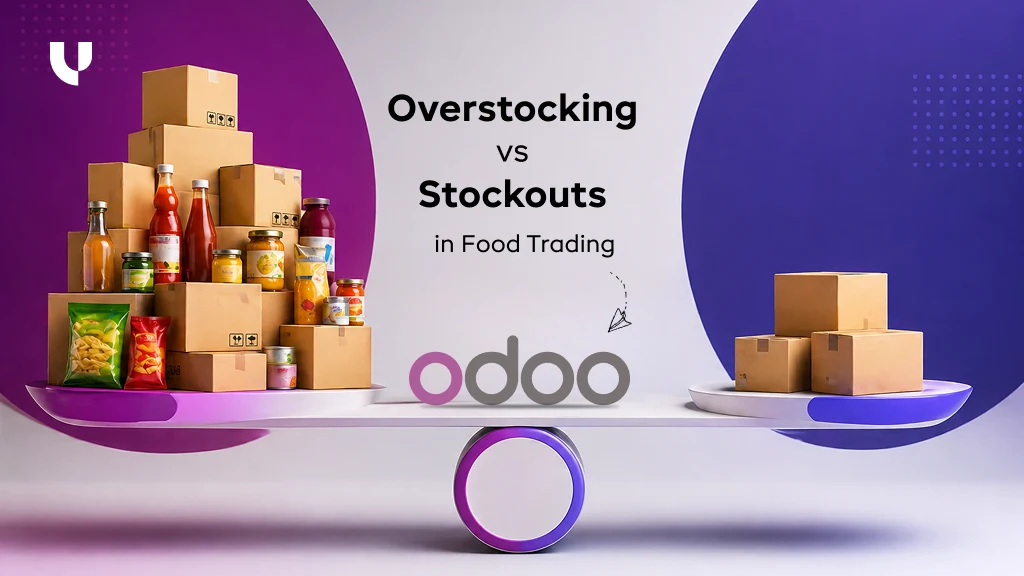
Most food trading businesses don’t run out of inventory. They run into situations where the current inventory doesn’t match the present demand.
Most businesses try to manage this using forecasts, spreadsheets, or fixed reorder rules.
On paper, it looks controlled. In reality, a lack of real-time information slows down decision-making, and teams end up with either too much or too little inventory.
The problem is not just bad forecasting; it is the lack of connection between sales, inventory, and procurement teams.
This is where systems like Odoo start to change the approach. By bringing these functions into a single flow, it becomes easier to plan inventory based on actual demand rather than assumptions.
This blog breaks down why inventory planning in food trading often swings between overstocking and stockouts, and how Odoo helps create a more balanced, demand-driven system.
Why Food Traders Struggle to Balance Inventory
Balancing inventory sounds simple, but it rarely is. You need to manage demand and stock levels, and replenish as needed.
In practice, it rarely works that cleanly, especially in food trading.
The challenge isn’t just demand uncertainty. It’s that multiple variables - shelf life, movement speed, and coordination across teams, all interact at the same time. When even one of these breaks, inventory starts drifting toward either excess or shortage.
Here’s a closer look at why food traders struggle to balance inventory:
1. Demand fluctuations and seasonality in food products:
Demand for food products is rarely stable. It changes based on seasons, trends, and external factors. Without accurate demand signals, businesses either overstock to stay safe or understock and risk losing sales.
What this leads to:
Forecasts quickly become outdated, and businesses either overstock to “play safe” or understock and lose sales.
Example:
A spike in demand during a festival leads to bulk ordering. The demand drops immediately afterward, leaving excess stock with a limited shelf life.
Uncanny’s Observation:
Most teams don’t get forecasting wrong; they just expect it to stay relevant for longer than it actually does.
2. Short shelf life increases pressure on inventory decisions:
Unlike non-perishable goods, food items have limited selling windows. This makes every inventory decision more time-sensitive. Holding excess stock is risky, but running out of stock is equally costly.
What this leads to:
Teams are forced to make quicker decisions, often without complete visibility.
Example:
A product with a 20-day shelf life sits in storage for 12 days due to slow movement. Even if demand exists, the selling window becomes too short.
Uncanny’s Observation:
Inventory doesn’t become a problem when it arrives; it becomes a problem when it doesn’t move on time.
3. Lack of real-time visibility across warehouses and sales channels:
When inventory data is not real-time, teams don’t get a clear picture of what’s available. This results in decisions that don’t apply to the present situation.
What this leads to:
Decisions are made based on partial or outdated information.
Example:
One warehouse holds excess stock nearing expiry, while another warehouse places a fresh order because it cannot see that inventory.
Uncanny’s Observation:
Most inventory problems are not about shortage; they are about not knowing where the stock actually is.
4. Disconnect between procurement, sales, and warehouse teams:
When these teams operate in silos, planning breaks down. Procurement may order based on assumptions; sales may not reflect actual stock levels; and warehouse teams deal with the consequences.
What this leads to:
Misalignment between what is ordered, what is promised, and what is available.
Example:
Sales confirms an order assuming stock is available, but the warehouse realizes that the available stock is already allocated or nearing expiry.
Uncanny’s Observation:
Inventory doesn’t break in one place; it breaks in the gaps between teams.
The Real Cost of Overstocking and Stockouts
Overstocking and stockouts are often treated as separate problems. In practice, both stem from the same issue: inventory decisions that are not updated as demand changes.
The impact does not show up all at once. It builds across cash flow, margins, customer relationships, and daily operations.
1. Capital gets blocked in excess inventory:
When products don’t move as expected, money gets tied up in stock that isn't generating revenue. This directly affects purchasing power.Businesses delay or reduce new orders, not because demand is low, but because capital is already tied up in slow-moving inventory.
2. Losses due to expiry and wastage:
In food trading, excess inventory does not just sit. It loses value over time and eventually becomes unsellable. What could have been revenue becomes a direct loss, especially in categories with a short shelf life.
This usually becomes visible only during stock checks, when products are already too close to expiry to recover value.
3. Missed sales and declining customer trust:
Stockouts create a different kind of loss. Demand exists, but the product is not available when needed. These missed sales are rarely tracked properly, but they affect reliability.When this happens repeatedly, customers start shifting to suppliers who can fulfill orders consistently.
4. Operational inefficiencies and constant firefighting:
Stockouts create a different kind of loss. Demand exists, but the product is not available when needed. These missed sales are rarely tracked properly, but they affect reliability.When this happens repeatedly, customers start shifting to suppliers who can fulfill orders consistently.
5. Operational inefficiencies and constant firefighting:
When inventory is not balanced, teams stop planning and start reacting:
- Procurement rushes orders
- Warehouses deal with uneven stock
- Sales work with uncertain availability
You can see it in day-to-day decisions: urgent purchases on one side, excess stock sitting unused on the other.
What does this really mean?
Overstocking and stockouts are not isolated issues. They are symptoms of the same underlying problem: delayed and disconnected decisions.
When left unaddressed, overstocking and stockouts don’t just affect inventory. They make the entire business harder to run. Odoo helps manufacturers reduce waste and optimize costs in multiple ways. Here’s a detailed blog post that offers insights into Odoo’s role in optimization.
Why Traditional Inventory Planning Fails
Traditional inventory planning doesn’t fail because businesses lack systems. It fails because the system cannot keep up with how demand actually behaves in food trading.
Planning usually starts with structure: forecasts are created, reorder levels are defined, and stock is managed based on expected demand. This works when conditions remain stable.
The problem begins when demand starts shifting. Here’s why traditional inventory planning fails:
-
Reliance on manual forecasting or spreadsheets: Many companies continue to plan inventory based on past trends and spreadsheets. While it’s a great first step, it’s not dynamic enough to keep up with operations at scale.
Example: The product has been moving consistently for 2 months, and hence, procurement is increasing. If demand suddenly falls off at a time of year when orders are still being placed at the same rate, excess stock is created. -
Static reorder rules that don’t adapt to demand changes: Fixed minimum and maximum stock levels may work initially, but they don’t adjust to fluctuating demand. As a result, businesses either hold excess stock or run out at critical moments.
Example: A product needs to be reordered as it hits 500 units. However, when demand slows, the system continues to reorder the product, resulting in overstocking. -
No integration between sales data and procurement planning:Sales and procurement teams often work with different data sets, which results in broken communication. It further results in differences in stocks across different regions.
Example: Category sales are down, but the team keeps ordering it because it is not directly linked to real-time sales data. -
Delayed decision-making due to lack of real-time insight:Teams lack real-time inventory and sales data, so they’re reacting late. In most cases, the stock problem is recognized too late to be solved without affecting operations.
Example: A product takes off faster than anticipated. This change is slow to be reflected in the system, and procurement is done after the stockout occurs.
Want to start a project with us?
Empowering businesses to achieve greatness through strategic guidance and innovative solutions.
Book A Demo
What Food Traders Actually Need to Balance Demand and Supply
Balancing demand and supply for food traders is not about knowing what will happen next. It is about managing the right information. Food traders need a system that puts together all the information they have and the decisions they make.
Here are a few key things that food traders need to balance demand and supply for food traders:
1. Real-time inventory visibility across locations:
Teams need to know how much stock they have in all their warehouses and sales channels. If they do not have this information, they will make decisions that are not entirely accurate. This can lead to having too much stock or not having enough stock when people want to buy it.
2. Demand-driven replenishment instead of guesswork:
The teams should make inventory decisions based on what's actually happening with sales and how stock is moving. Inventory decisions should be based on sales patterns and movement of stock, not just what they think will happen.
3. Smart reorder rules based on sales patterns:
Reorder points should not remain fixed. They need to adapt based on product performance, seasonality, and demand trends to avoid imbalances.H3
4. Coordination between procurement, sales, and warehouse teams:
All teams need to work with the same data. When procurement, sales, and warehouse operations are aligned, inventory planning becomes more accurate and consistent.
5. Alerts for both overstock risk and potential stockouts:
The system should flag both sides of the problem:
- Excess inventory that may lead to expiry
- Low stock that may lead to missed sales
Knowing both the factors allows teams to act early.
How Odoo Helps Balance Overstocking and Stockouts
Inventory balancing is not about eliminating uncertainty; it is about reacting faster to it with the right information. Odoo connects inventory, sales, and procurement, so decisions are based on what is really happening rather than assumptions.
Here’s how Odoo manages overstocking & stockouts:
1. Automated reorder rules based on demand and lead time:
Companies can make rules for reordering things in Odoo. This way, the stock gets filled up at the time, so you do not have excessive inventory sitting around.
What changes?
Stock is replenished according to the real speed of movement, not just the passing of a threshold.
Example:
If a product is selling quicker than usual, the system triggers replenishment earlier. If demand falls, it stops unnecessary ordering that could result in excess stock.
2. Real-time inventory tracking in warehouses:
You can check inventory levels in real-time. This is helpful because it prevents you from ordering too much of something in one place when another place has none.
What changes?
Teams can no longer afford to make assumptions or rely on old reports. They can see exactly what is there and where it is.
Example:
Instead of placing a new order, a team finds surplus stock in another warehouse and moves it to cover demand. This keeps one warehouse from having too much stock while another has too little.
3. Integration between sales, purchase, and inventory modules:
Since all modules are connected, sales data directly influences procurement decisions. This alignment ensures that ordering is based on actual demand rather than isolated planning.
What changes?
Procurement aligns with actual demand instead of continuing based on earlier assumptions.
Example:
When sales of a product decline, the company automatically reduces the amount of the product it buys. This helps stop much of the product from building up in stock.
4. Forecasting insights to support better procurement decisions:
Odoo provides real-time visibility into demand trends and stock movements. This helps teams figure out what they will need in the future. They can look at demand trends and stock movements to help them make decisions.
What changes?
Teams can change their decisions at the moment of waiting for the next planning cycle.
Example:
If demand for a product begins to slow mid-month, the procurement team can make changes. This prevents ordering large quantities of something based on old forecasts that are no longer accurate.
5. Visibility into slow-moving and fast-moving products:
Teams can see what’s selling fast, and what’s not, product-wise. They can change what they buy, what they charge, or what specials they have using this information. This helps them avoid having too much of something that isn't selling and missing out on things people really want to buy.
What changes?
Teams can act early rather than react after stock becomes a problem.
Example:
A slow-moving product is identified early, allowing the business to reduce ordering or run promotions before it turns into dead stock.
The Bigger Picture
Overstocking and stockouts are not separate problems. They come from the same issue: delayed or disconnected decisions.
How Odoo Connects Sales, Inventory, and Procurement Daily
Balancing inventory is not about accurately predicting demand. It is more about being able to react to changes with good information.
Most teams already have planning in place. They use forecasts, reorder levels, and periodic reviews. The problem is that these rules do not change when things change.
Odoo does things differently. It brings sales, inventory, and purchase history together on a single platform, allowing people to make decisions seamlessly and without hassle.
Here’s how that works in practice:
1. Sales orders automatically impact demand planning:
Every sales order updates demand in real time. As orders come in, the system reflects actual requirements, helping teams plan inventory based on live demand instead of assumptions.
What changes?
Replenishment happens based on how products are actually moving, not just because a threshold is reached.
Example:
A product selling 50 units a week suddenly moves to 120. Without adjustment, the stock runs out within days. With Odoo, replenishment triggers earlier due to increased movement.
2. Procurement triggered based on stock levels and forecasts:
When the stock falls below a certain level or rises above it, procurement is triggered. It reduces manual involvement and ensures there’s adequate stock every time.
What changes?
Procurement aligns with real demand instead of continuing based on earlier assumptions.
Example:
When a specific product is selling slowly, procurement triggers automatically reduce its replenishment, preventing stock buildup.
3. Warehouse teams working with accurate, real-time stock data:
Warehouse teams no longer rely on delayed reports or manual checks. They work with updated stock levels, which improves picking accuracy and reduces confusion.
What this changes:
Teams have access to better data and up-to-date information rather than delayed reports and assumptions.
Example:
A warehouse can track near-expiry products and deliver them to locations where there is demand for the product. This helps brands avoid any wastage and maintain procurement.
4. Continuous adjustment of stock levels based on actual movement:
As products are sold, received, or transferred, inventory levels adjust instantly. This ongoing update cycle helps maintain balance without requiring constant manual intervention.
What changes?
Teams have the flexibility to adjust decisions as demand shifts, rather than waiting for the upcoming cycle.
Example:
If demand for a product declines mid-month, procurement slows, as the data suggest that stocking products could result in a loss.
Odoo in Action
Overstocking and stockouts are not separate problems. They come from the same issue: delayed or disconnected decisions.
Inventory doesn’t go out of balance suddenly; it drifts. The advantage here is not just better planning, but the ability to catch that drift early, before it turns into excess stock or lost sales.
Business Impact of Getting Inventory Balance Right
When inventory starts to balance out, the change is not dramatic; it’s gradual, but noticeable across operations:
#1 Reduced wastage and better cash flow:
When excess stock is avoided, fewer products expire on the shelf. Inventory moves more consistently, and cash is not tied up in unsellable stock.
#2 Higher product availability and improved customer satisfaction:
Products are available when customers need them. This means orders are filled reliably, which is good for the customer experience and encourages repeat business.
#3 More predictable operations and fewer last-minute decisions:
Teams do not have to spend much time dealing with stock issues. This makes planning a lot easier, and things run more smoothly with fewer problems.
#4 Better control over procurement and storage costs:
Purchasing decisions become more accurate, and storage space is used more efficiently. This allows teams to prevent unnecessary orders, saving costs over time.
Best Practices to Balance Demand and Supply Effectively
There is no proven formula for balancing inventory. It’s a continuous effort of analyzing real-time data and inventory while making decisions.
Here are some best practices for balancing demand and supply effectively:
1. Use historical sales data to inform forecasting:
Past data is really useful if you want to get customers to come back. This information tells you what people like to buy and which things are popular during certain times of the year.
2. Always keep track of your fast and slow movers:
It’s important to track how your inventory changes over time. Fast-moving goods often slow down or speed up relative to others. Regular review of the product movement helps you avoid over- or understocking.
3. Dynamic reorder rules rather than fixed thresholds:
Fixed reorder levels often fail when demand changes. Rather than changing the order based on rules, figure out recent sales patterns and how long it takes to get new stock. This way, inventory levels can adjust to changes in what people want to buy. It further reduces the risk of overstocking and stockouts.
4. Align procurement cycles to actual demand patterns:
Procurement should not be scheduled, but should be based on actual consumption. Ordering early or late creates an imbalance. If purchases align with real demand, inventory will turn over more smoothly, and storage pressure will be reduced.
5. Regularly monitor inventory performance metrics:
Indicators such as stock turnover, aged stock, and stock cover can help to indicate where planning is going wrong. Real-time inventory updates give teams the opportunity to detect issues early.
Choosing the Right Approach with Odoo
Odoo can help with on-demand, driven inventory planning. It really depends on how well you set it up and how well it fits your business operation. The difference is not in Odoo, but in how your Odoo implementation mirrors how your business really works.
Here are the key steps to picking the approach with Odoo:
1. Configure Odoo based on real demand patterns:
They have to set up reorder rules, lead times, and stock levels that reflect how the products actually flow. Generic settings often cause the same problems (overstocking or stockouts) just in a new system.
2. Ensure integration across sales, inventory, and procurement:
When all these functions are integrated, Odoo works well. The sales team is active and should be impacting the inventory and the items to be bought. Then the planning is based on reality, not on guesses unrelated to what is really going on.
3. Work with the right implementation approach:
A system that looks fine may still have problems when you use it every day. This is when people's efforts are out of step. “Let’s get our processes in order, then let’s get the system to support them. The system should support workflows to ensure smooth operation.
Uncanny works with businesses to implement Odoo in a way that reflects actual operational flow, from demand planning to procurement and inventory movement.
Moving from Reactive Inventory to Demand-Driven Planning
Most inventory issues don’t come from a lack of effort; they come from reacting too late.
Balancing overstocking and stockouts starts with moving away from reactive decisions and building a system that responds to actual demand in a structured way.
The first step is understanding where visibility breaks down today. This can be in forecasting (demand is roughly estimated), stock movement (data is delayed), or in coordination (teams are not working with the same information). Discovering these gaps will help us understand why the planning is not working properly.
Properly configured Odoo will help you synchronize demand and supply. It means a streamlined workflow, with everything from sales to inventory managed through an intuitive platform.
Uncanny is here to help you with end-to-end setup, from configuring Odoo to match your real business flows to providing the licenses you need.
This means the system is designed and implemented to support a reliable, scalable inventory planning process over the long term.
FAQs
Q. What causes overstocking and stock-outs in food trading?
Inventory problems usually arise from a lack of data and insight. Apart from real-time data, the lack of communication between teams across sales, purchasing, and warehousing could be another reason for overstocking and stock-outs.
Q. How do food businesses manage demand and supply well?
Real-time data helps teams plan based on demand. Additionally, flexible rules for reordering products further simplify demand and supply in the food business.
Q. What are some of the best ways to do inventory planning with Odoo?
Thanks to data, tracking of product movements, dynamic adjustment of reorder rules, and periodic review of inventory performance, Odoo helps you to plan more accurately and with more certainty.
Q. What are automated reorder rules in Odoo?
It starts by buying based on stock levels, demand trends, and lead times, ensuring it is replenished without manual inventory management.
Q. Why is real-time inventory visibility important to food traders?
Odoo enables sales, procurement, and warehouse teams to make decisions to avoid overstocking or stock-outs and provides better inventory control across locations.
Found this post helpful? Be sure to share it with your network!


About Author
Ankit Gauri is the Chief Executive Officer of UNCANNY Consulting Services, specializing in Odoo, ERP strategy, and digital transformation. With extensive experience helping businesses streamline operations and accelerate growth, he focuses on delivering scalable technology solutions that align business processes with long-term organizational goals.


Ankit Gauri is the Chief Executive Officer of UNCANNY Consulting Services, specializing in Odoo, ERP strategy, and digital transformation. With extensive experience helping businesses streamline operations and accelerate growth, he focuses on delivering scalable technology solutions that align business processes with long-term organizational goals.