Virtual Shopping Assistant: Benefits, Use Cases & Examples
Read by: 4

Jigar Jariwala
Delivery Head
Jigar Jariwala is the Delivery Head at UNCANNY Consulting Services with expertise in Shopify, Mobile App Development, WordPress, and website design. He helps businesses build customer-centric digital experiences that drive engagement, improve online performance, and support long-term growth.
Published on October 8th 2026

Overview
Today's consumer expects answers right away. Meeting such an unprecedented set of questions was once nearly impossible, but now, in 2026, retailers are exploring AI shopping assistants to answer them in real time. This guide explains how these assistants work, their benefits, and how to clean up before going live.
Introduction
AI shopping is no longer a niche habit; it’s a lifestyle choice.
Retail Report by Adyen suggests that 37% of shoppers now use AI to shop, a 47% jump from the year before.
Wonder why? Because it changes the way users shop.
An online store can have thousands of products, but customers still rely on reviews to complete their purchase. That's where an AI personal shopper makes the difference: it understands their unique requirements and compares similar brands or alternatives.
With reliable inventory and good data management, a virtual shopping assistant becomes an indispensable part of your sales team.
But What Is a Virtual Shopping Assistant?
A virtual shopping assistant is software designed to help customers locate, compare, and buy goods. The software engages in conversation with the customer the same way a salesperson in a shop does.
Alternative names are digital shopping assistant, online shopping assistant, or personal AI shopper. It simply performs the tasks a good retail worker would for every customer.
An assistant figures out what the shopper is trying to do. "Something for a beach trip next week, under $60" might look like a very low-competition target query in search, but it becomes a buying intent for an assistant.
How Does an AI Shopping Assistant Work?
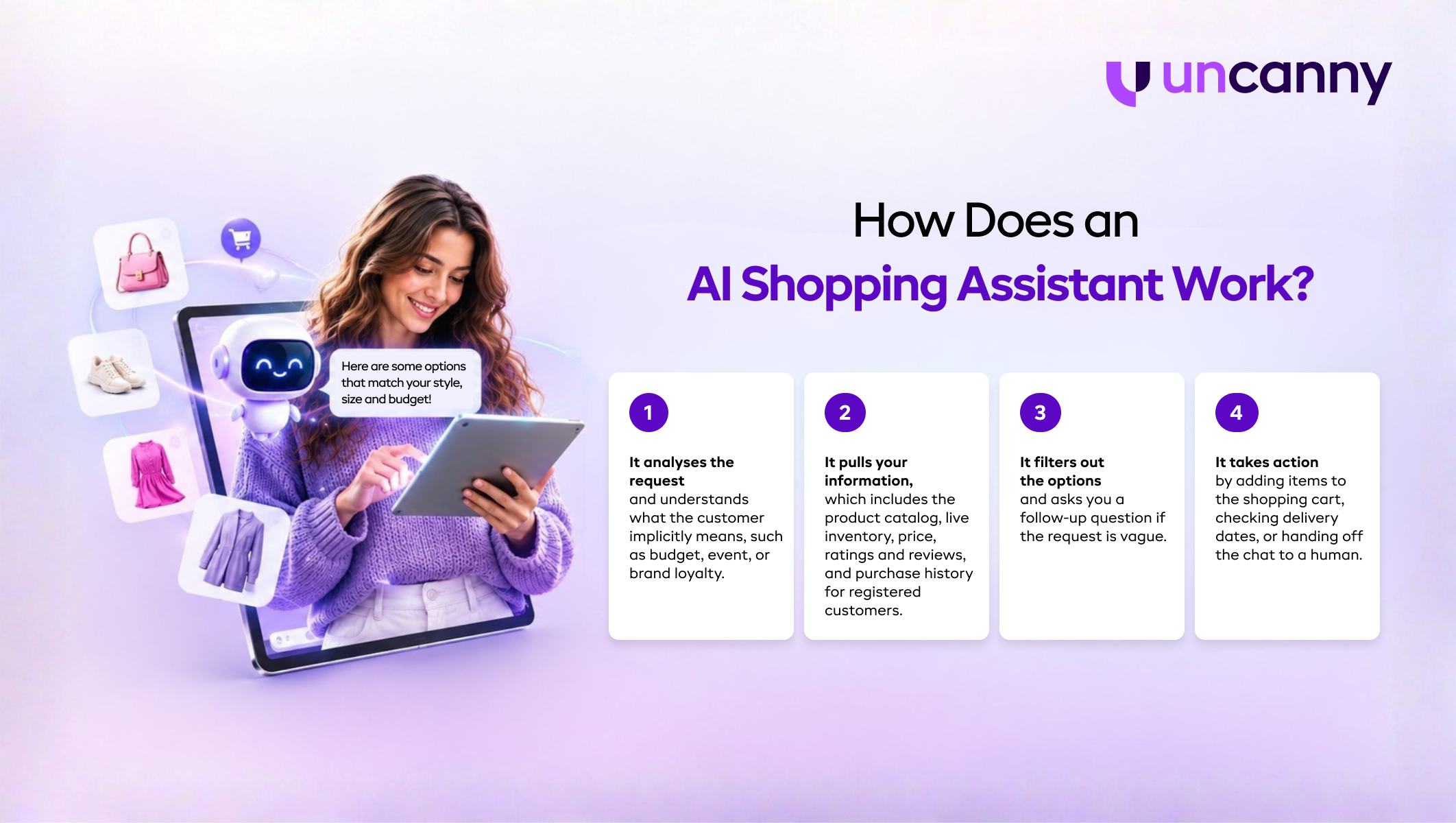
From the shopper's side, an AI shopping assistant looks like one quick reply. Behind it, four steps run in order.
- It analyses the request and understands what the customer implicitly means, such as budget, event, or brand loyalty.
- It pulls your information, which includes the product catalog, live inventory, price, ratings and reviews, and purchase history for registered customers.
- It filters out the options and asks you a follow-up question if the request is vague.
- It takes action by adding items to the shopping cart, checking delivery dates, or handing off the chat to a human.
Most failures happen at step two. If the inventory feed is a day old, it will recommend a product that sold out this morning. An assistant is only as good as the data it's plugged into.
Top Use Cases of Virtual Shopping Assistants
Not every store needs every use case on day one. Most start with one, see results, and build from there.
a. Personalized Product Recommendations
Say a shopper asks for running shoes. A regular product widget shows the bestsellers and calls it a day.
An assistant asks the right questions first. Road or trail? Which brands have fit well before? Then it checks their size against what's actually in stock.
The result? Four relevant pairs instead of forty, and a much shorter road to checkout.
b. Cross-Selling and Upselling
Most "you may also like" sections feel random, and shoppers scroll right past them.
An assistant makes the suggestion part of the conversation. Buying a camera for a vacation? It nudges you toward a spare battery and a travel case. It reads like advice, not a sales pitch, and that's why it works.
c. Abandoned Cart Support
Around 7 in 10 online carts are abandoned, according to Statista. Most brands respond with the same reminder email for everyone.
An assistant looks at why the shopper stopped. Stuck on shipping costs? It offers a cheaper delivery option.
You only discount when price is actually the problem, which protects your margins.
d. Customer Support
Where's my order? How do returns work? Is this back in stock?
These questions make up a big chunk of support queues, and an assistant answers them in seconds using real order data. Gartner expects at least 70% of customers to start service conversations with conversational AI by 2028.
Your team, meanwhile, gets to focus on the tricky stuff, like damaged deliveries and billing disputes.
Benefits of AI Shopping Assistants for Ecommerce
The use cases show what an assistant does day to day. The benefits are what you notice after a few months of running one.
Better Shopping Experience
Shoppers rarely leave because you don't have the right product. They leave because it takes too long to find it, even if they're asking for it.
In a Statista survey, 76% of consumers said they want AI shopping assistants when they shop online.
Personalized Customer Journey
Every conversation teaches the assistant something: sizes, budgets, favorite brands. Returning shoppers don't start from scratch.
When a store remembers you, you have less reason to compare prices elsewhere.
24/7 Customer Assistance
A question at midnight often turns into an email answered the next afternoon. By then, the shopper has already bought from someone else. With an assistant, they get the answer while they're still on the product page.
Higher Conversion Opportunities
Salesforce found that during the last holiday season, retailers running their own shopping agents grew sales 59% faster than those that didn't, and it makes sense. Guided shoppers hesitate less, and hesitation is exactly where online sales slip away.
Improved Business Efficiency
Every repeat question the assistant handles is one less ticket in your queue, which matters most during peak season.
There's a bonus, too… every chat shows what shoppers ask in their own words, exposing unclear product pages and catalog gaps no dashboard would catch.
Real-World AI Shopping Assistant Examples
Some of the biggest names in retail already have assistants live, and each took a different path.
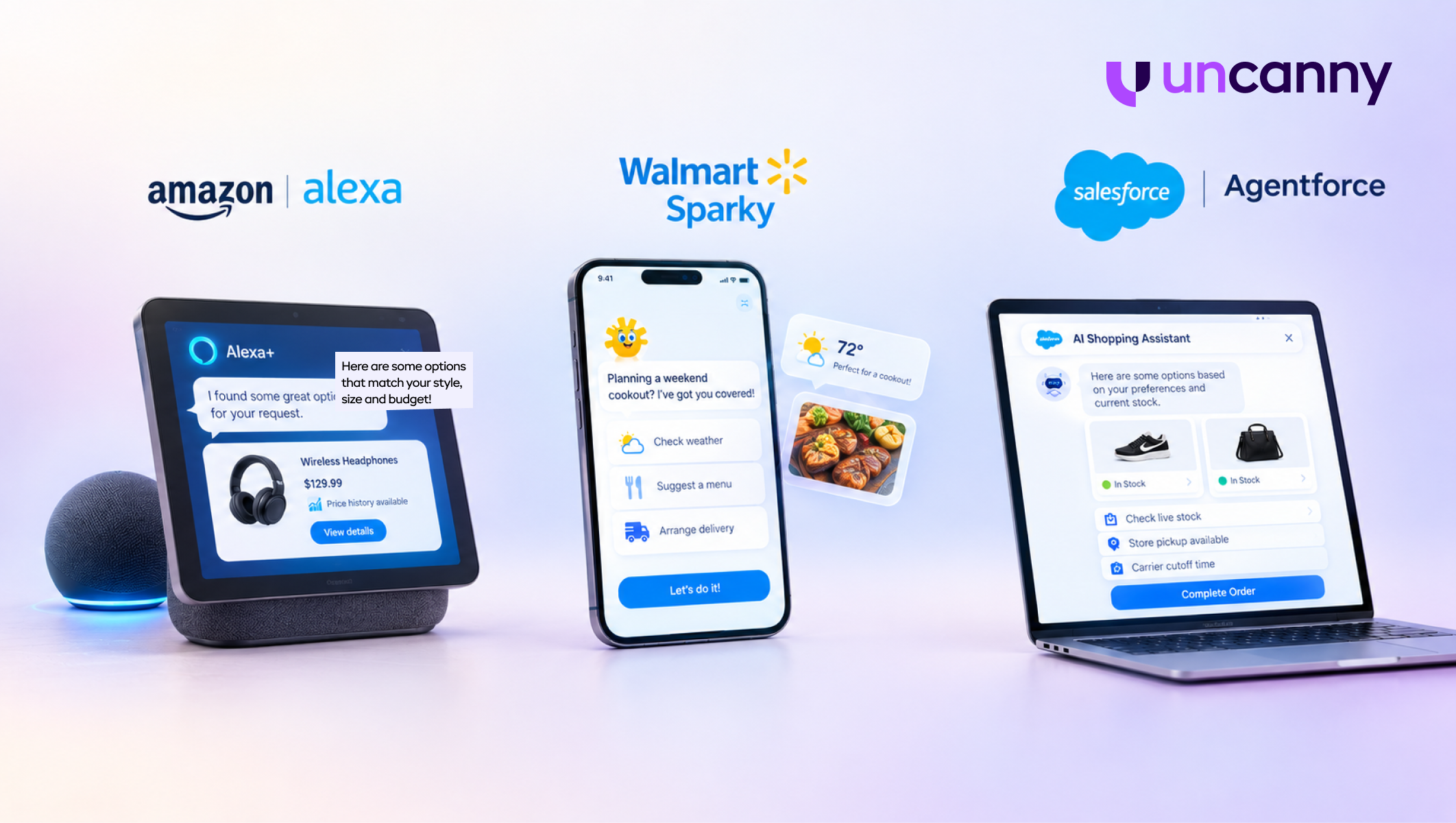
Amazon Alexa Shopping
In May 2026, Amazon merged Rufus, which helped more than 300 million customers in 2025, with Alexa+ to launch Alexa for Shopping. It compares products, shows up to a year of price history, and can buy an item once its price drops.
The smart move was placement, as Amazon didn't put the assistant next to search; it turned it into search.
Walmart Sparky
Walmart launched Sparky in its app in June 2025. Planning a weekend cookout? Sparky checks the weather, suggests a menu, and lines up delivery.
The move is paying off so far, as in February 2026, CEO John Furner said Sparky users' orders were about 35% bigger than everyone else's.
Salesforce Agentforce
Salesforce went a different way, giving retailers the tools to build their own. Its Agentforce Commerce Shopper Agent runs on the retailer's storefront, where it checks live stock and carrier cutoffs, offers store pickup, and closes the order in one chat. For most brands, this is the model worth studying.
AI Shopping Assistant vs Traditional Ecommerce Chatbot
Many stores think they already have an AI shopping assistant because there's a chat bubble in the corner. Chances are, it's a rules-based chatbot.
Here's how the two compare.
| Traditional Chatbot | AI Shopping Assistant | |
|---|---|---|
| How it understands | Keywords and preset menus | Natural language, including vague requests |
| What it knows | A fixed FAQ script | Catalog, stock, orders, and customer history |
| Main job | Deflecting support tickets | Guiding the purchase through checkout |
| Off-script questions | Loops or says it didn't understand | Asks a follow-up or hands off to a person |
| Taking action | Rarely | Adds to cart, checks delivery, applies offers |
Challenges to Consider Before Implementation
A bad assistant does more damage than none, because it fails in front of your customer. Plan for these four things.
Accuracy
One wrong answer about stock or returns, and the trust is gone. Connect it to live data and review its mistakes every week.
Data Privacy
Keep only the customer data the assistant needs, be upfront about it, and follow the rules in your markets, like GDPR or CCPA.
Poor Conversations
Nobody wants to answer six questions before seeing a single product. Show options early and let shoppers narrow down from there.
Human Support
A damaged order or an upset customer needs a real person. Hand those chats over with the history attached, so nobody has to explain twice.
The Future of Virtual Shopping Assistants
So, where is all this heading? Toward assistants that don't just suggest, but act.
Amazon's assistant can already complete certain purchases on its own once a shopper sets the conditions.
Shoppers are getting there, just slowly.
Adyen found that 55% are open to buying through AI, yet a 2026 Gartner survey found only 31% of US consumers would let AI narrow their choices for household supplies. They want help, not a machine making the call.
That changes what visibility means. When an AI personal shopper makes the selection, your product gets chosen only if you provide enough information that is comprehensible and trustworthy for the AI to recognize. Your product ranking on search result pages no longer matters.
Want to start a project with us?
Empowering businesses to achieve greatness through strategic guidance and innovative solutions.
Book A Demo
Conclusion
AI shopping assistants aren't just for Amazon-sized budgets anymore. Whether your business needs one depends on the business model. It comes down to the data behind it, the handoff to your team, and whether it fixes a problem your shoppers actually have.
So if you’re planning, start small and pick one use case, like sizing questions or cart recovery, measure it, fix what breaks, and then expand.
As AI starts building shortlists for shoppers, it also helps to make sure your product pages are ready to be picked. That's the kind of SEO, AEO, and GEO work we do at UncannyCS.
Get it right, and your assistant won't feel like a chatbot you bolted on. It'll feel like having your best salesperson on the floor, around the clock.
About Author
Jigar Jariwala is the Delivery Head at UNCANNY Consulting Services with expertise in Shopify, Mobile App Development, WordPress, and website design. He helps businesses build customer-centric digital experiences that drive engagement, improve online performance, and support long-term growth.