7 Production Challenges Milk Processing Plants Face During Capacity Expansion
Published on June 23rd 2026

Overview
This blog takes a closer look at the different challenges involved in milk production. The following sections take a deep dive into everyday function, management, and inventory operation for manufacturers and how a reliable dairy ERP streamlines operations as they scale.
Introduction
Scroll through dairy industry discussions on Quora, and you'll come across a recurring question:
"What are some of the challenges and emerging issues concerning milk production?"
The answers are rarely about demand itself.
In most cases, the real problems start after the expansion. More milk intake means more production planning, more inventory movement, more quality checks, and more pressure on pasteurization schedules, cold chain operations, and batch traceability processes.
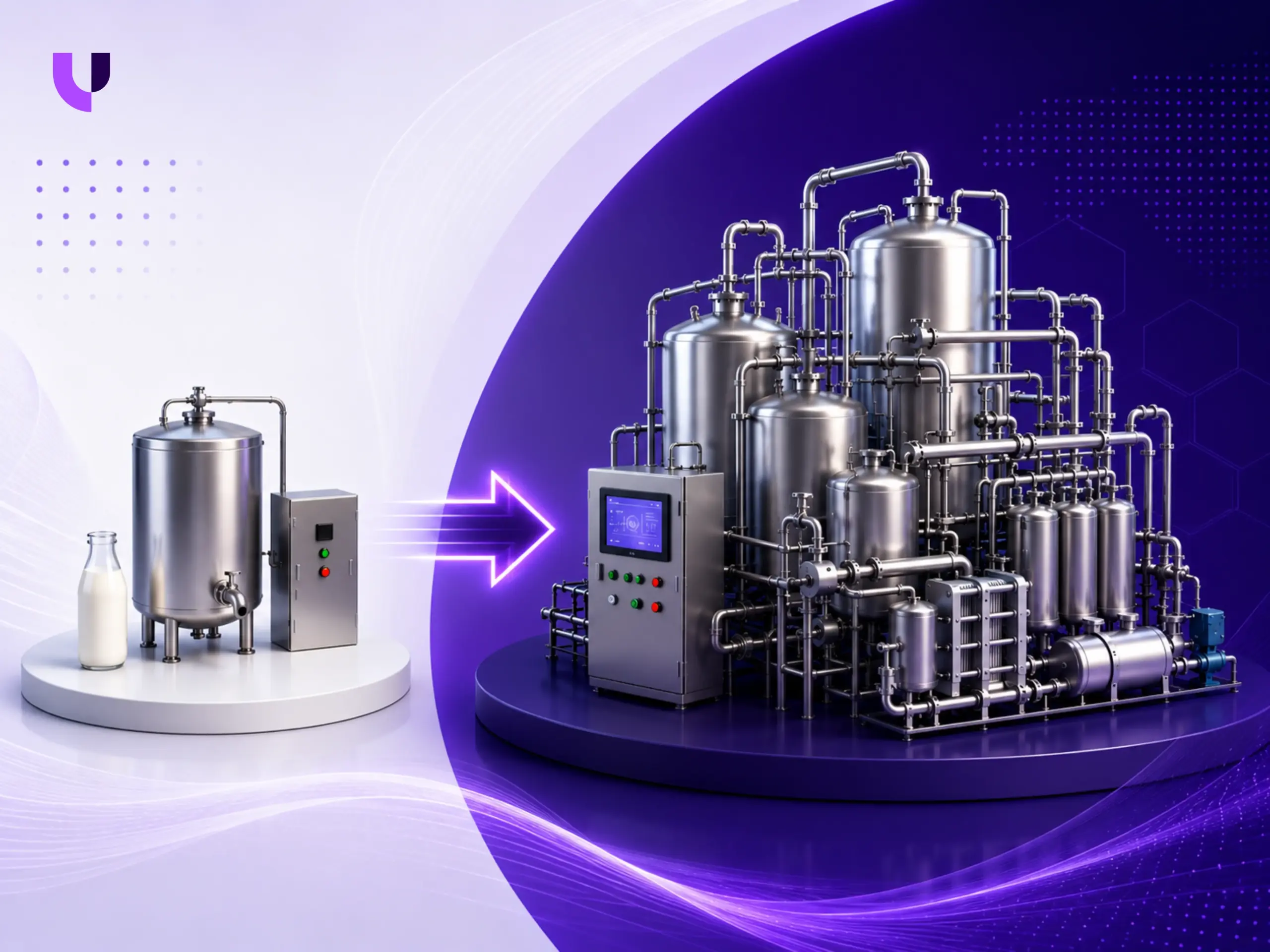
What works for a plant processing 50,000 liters per day may not work as well at double the volume.
Operational control is also reinforced by industry data. With the expansion of operations, visibility into the production process and inventory management is even more critical as food manufacturers continue to face substantial losses due to inefficiencies, waste, and supply chain problems.
This is where dairy-specific ERP software becomes valuable. Connecting milk reception, production, inventory, quality management, compliance, and dispatch activities, it helps manufacturers expand output without losing control of day-to-day operations.
In this article, we explore seven production challenges milk processing plants commonly face during capacity expansion and how dairy ERP technology can help address them.
Capacity Expansion Challenges - At A Glance
| Challenge | Operational Impact | ERP Contribution |
|---|---|---|
| Increased Intake | Receiving and processing bottlenecks | Intake planning and production scheduling |
| Consistent Quality | Batch variations and process deviations | Quality monitoring and batch tracking |
| Multiple Product Lines | Scheduling conflicts and resource competition | Centralized production planning |
| Inventory Growth | Waste and stock visibility issues | Inventory and shelf-life management |
| Equipment Downtime | Production interruptions | Preventive maintenance planning |
| Compliance & Traceability | Documentation and audit complexity | Digital records and traceability |
| Operational Visibility | Delayed decision-making | Unified real-time data visibility |
7 Capacity Expansion Challenges Milk Processing Plants Must Solve for Sustainable Growth
Adding more capacity to your production is usually the easy part. The greater challenge is keeping operations smooth while maintaining more inventory and product SKUs every day.
Here’s a closer look at the seven capacity challenges milk processing plants must solve for growth:
1. Managing Increased Milk Intake Without Creating Processing Bottlenecks
Higher milk volumes can overwhelm receiving, testing, storage, and processing operations.
Why does it become a problem during expansion?
One of the first signs of strain usually appears during procurement. Tankers are waiting longer to unload, laboratory testing is taking longer, and storage silos are filling faster than expected.
What was once a predictable intake process can quickly become difficult to coordinate as daily milk volumes increase. Production teams often find themselves adjusting schedules simply to keep milk moving through the facility.
As volumes continue to grow, these delays begin to affect pasteurization scheduling, production throughput, and inventory planning. A bottleneck at the receiving stage can eventually impact the entire production cycle, from processing to dispatch.
Solution
Milk processing ERP software helps manufacturers coordinate milk reception, storage allocation, quality testing, and production scheduling from a single platform. With better visibility into available capacity and milk availability, teams can plan processing activities more efficiently and reduce delays across operations.
With a reliable ERP in place for production, businesses achieve improved milk flow, faster processing decisions, and better utilization of available production capacity.
2. Maintaining Product Quality and Consistency Across Larger Batches
Mass production increases the risk of quality variations and process deviations.
Why does it become a problem in the expansion?
With higher production volumes, it is more difficult to ensure quality unless monitoring processes change. FAO statistics suggest that approximately 13.3% of food produced globally is lost between harvest and retail.
A dairy plant that produces larger batches of pasteurized milk, flavored milk, yogurt, or other dairy products must also ensure that each production run is of the same quality. Even small variations in temperature, timing, ingredient handling, or quality control checks can affect consistency.
When several lines are running at the same time, the challenge is even bigger. Quality teams are responsible for monitoring more batches, more testing requirements, and batch traceability without slowing production.
As traceability expectations evolve, it is increasingly important for manufacturers under FSSAI regulations to maintain accurate production and quality records.
Solution
Dairy processing ERP software helps automate quality monitoring by integrating records of production, quality inspections, batch traceability, and corrective actions into a single system. This allows manufacturers to identify errors earlier and achieve more consistent product quality at higher production volumes.
Having an ERP in place results in better batch consistency, better quality control, and more traceability across growing operations.
3. Coordinating Multiple Product Lines Without Disrupting Production
New products and SKUs increase production complexity and resource conflicts.
Why does it become a problem during expansion?
Adding a new product sounds simple on paper.
In practice, every new SKU competes for the same equipment, people, packaging materials, storage space, and production time. A line producing pasteurized milk in the morning may need to switch to flavored milk later in the day, while yogurt production waits for packaging materials to arrive.
This is usually when production schedules start changing constantly. One delay affects another process, which then affects the next one. Before long, planners spend more time adjusting schedules than following them.
The issue is not the number of products. It is the growing number of dependencies between them.
Solution
Centralize production planning using dairy manufacturing software solutions. By connecting production schedules, inventory availability, order requirements, and resource planning, manufacturers can coordinate multiple product lines with fewer disruptions.
Better production flow, improved resource utilization, and smoother execution across growing product portfolios.
4. Controlling Inventory Growth While Minimizing Waste
Managing larger inventories of milk, ingredients, packaging materials, and finished goods becomes more difficult as production expands.
Why does it become a problem during expansion?
Walk through a warehouse after a capacity expansion, and you'll often notice the same thing: more inventory than ever before.
Additional raw milk is arriving daily. More packaging materials are being ordered to support higher production targets. Finished dairy products are occupying more cold storage space as they wait for dispatch.
At first, this feels like a sign of growth.
The problem arises when teams lose track of what should move first. A pallet of yogurt nearing expiry may be sitting behind newer stock. Packaging materials purchased months ago may still be occupying storage space. Inventory is available, but not all of it is equally useful.
For dairy manufacturers, shelf life makes these mistakes expensive. According to the FAO, roughly 14% of food produced globally is lost before reaching retail markets, making inventory control and stock rotation increasingly important as operations scale.
Solution
Leverage ERP software for dairy manufacturers to improve inventory visibility, monitor shelf life, support FEFO (First Expired, First Out) inventory rotation, and manage cold chain inventory more effectively. This helps teams make inventory decisions based on both stock availability and product freshness.
Lower wastage, improved inventory turnover, and stronger control over perishable dairy inventory.
5. Preventing Equipment Downtime During Higher Production Runs
Increased equipment utilization raises the risk of breakdowns and maintenance issues.
Why does it become a problem during expansion?
A pasteurizer rarely fails without a warning, and the signs usually appear much sooner.
- Operators experience longer cleaning cycles.
- The same machine complaints are starting to come in to the maintenance teams.
- The unit requires small adjustments more frequently.
Equipment is still running, but it’s working a lot harder than it was designed to just a few months ago.
Capacity expansion usually exacerbates these problems. The machines used to have downtime between production runs, but now they can run almost continuously. Production targets must be met, and small problems become big problems, so planned maintenance is postponed.
It’s not just about fixing equipment when it breaks. It flags problems before they begin to affect milk production, pasteurization schedules, packing operations, and dispatch commitments.
Solution
With dairy ERP software, it becomes easier to schedule preventive maintenance and track equipment performance. Maintenance teams can see equipment usage, service history, recurring issues, and scheduled maintenance all from one system, making it easier to address potential problems before they impact production.
Ultimately, it results in less downtime, better equipment reliability, and more consistent dairy production performance.
6. Meeting Compliance and Traceability Requirements at Scale
Expansion increases documentation, audit, food safety, and traceability requirements.
Why does it become a problem during expansion?
Nobody thinks much about traceability records on a normal production day.
The pressure usually arrives when someone asks a question.
- A customer wants details about a shipment.
- A quality issue needs to be investigated.
- An auditor asks where a particular batch came from and where it was sent.
What should be a simple answer can turn into hours of searching through files, spreadsheets, emails, and production records.
As more milk suppliers, production batches, and finished products move through the plant, handling those requests becomes harder. The records exist, but finding the right ones quickly becomes the challenge.
Solution
Digitizing dairy ERP for batch traceability and compliance management allows manufacturers to quickly obtain traceability information by integrating production records, quality inspections, inventory transactions, and dispatch activities, eliminating the need to manually retrieve records.
It further results in better compliance readiness, better batch traceability, and faster response times during audits, investigations, and recalls.
Regulatory Note:
FSSAI's food safety framework places increasing emphasis on traceability, documentation, and record maintenance.
7. Gaining Real-Time Visibility Across Expanding Operations
Growth often creates data silos and delays decision-making.
Why does it become a problem during expansion?
Try asking three different teams how much inventory is available.
- The warehouse may give one number while production may provide another.
- Sales may be working with something completely different.
Nobody is necessarily wrong; they are simply looking at different information collected at different times.
This becomes more noticeable as operations grow.
Small gaps between departments that were once manageable start affecting planning, purchasing, production schedules, and customer deliveries.
The problem is not a lack of information. It is the amount of time spent figuring out which information is actually correct.
Solution
Connect production, inventory, procurement, maintenance, quality management, and dispatch activities within a unified dairy ERP platform. Real-time access to operational data helps teams make faster decisions using the same information.
Moreover, having a reliable dairy ERP allows better visibility, faster decision-making, and stronger coordination across expanding dairy operations.
Want to start a project with us?
Empowering businesses to achieve greatness through strategic guidance and innovative solutions.
Book A Demo
Why Dairy-Specific ERP Software Becomes Essential for Managing Capacity Expansion
| Why ERP Becomes Essential | How It Helps During Expansion |
|---|---|
| Prevents Production Bottlenecks | Improves intake planning, production scheduling, and resource utilization |
| Improves Product Quality and Batch Consistency | Supports quality monitoring and process standardization |
| Provides Better Control Over Inventory and Raw Materials | Enhances stock visibility and shelf-life management |
| Enables Faster Operational Decisions | Gives teams access to real-time production and inventory data |
| Supports End-to-End Traceability | Simplifies compliance, audits, and product tracking |
Many of the challenges discussed earlier do not appear to be due to production increasing. They appear because visibility does not increase at the same pace.
That is where dairy-specific ERP software becomes valuable. Instead of relying on separate records, spreadsheets, and departmental updates, processors gain a connected view of milk procurement, production, quality, inventory, and dispatch as operations continue to grow.
Why Dairy Manufacturers Choose UncannyCS for Sustainable Growth
Adding production capacity is only one part of dairy business growth.
The bigger challenge is maintaining control as milk intake, production volumes, inventory levels, compliance requirements, and product complexity continue to increase.
The seven challenges discussed in this article show that expansion often places pressure on planning, quality, inventory, maintenance, traceability, and day-to-day operations.
Managing these areas through disconnected systems becomes increasingly difficult as dairy output grows.
This is where UncannyCS's dairy-specific ERP solutions help. Our dairy ERP services enable dairy manufacturers to improve efficiency, strengthen traceability, and support long-term growth with greater confidence. Contact us to learn more about how we can streamline your operations.
Besides, if you’re a manufacturer looking to move to the next phase of production, now could be the best time to plan it through. Visit our booth at the Odoo Experience 2026 in Belgium, September 24-26, to explore the next generation of possibilities. Hurry, book a call today!
FAQs
Q. What are the biggest production challenges during milk processing plant expansion?
Some of the biggest production challenges milk production plants face during scaling their business revolve around managing raw materials and deliverables. Teams struggle to switch between product lines, manage data, and maintain quality.
Q. How does milk processing ERP software help dairy manufacturers scale operations?
Having a milk-processing ERP software allows dairy production houses to manage every aspect of their operations, from raw milk procurement to storage and distribution, on a single platform. It saves time and improves efficiency.
Q. Why is inventory management important during dairy capacity expansion?
Inventory management plays a crucial role in dairy capacity expansion because products have a comparatively short lifespan. Not knowing the batch dates can confuse stock visibility and create an imbalance in demand and supply.
Q. How can dairy ERP software improve production planning?
Having a dairy ERP software in your workflow enables real-time operations, allowing business owners to check their current inventory levels. This way, teams have a better idea of how much to procure and what to produce.
Q. What role does traceability play in large-scale dairy manufacturing?
Traceability is a crucial aspect of large-scale dairy manufacturing. It handles quality issues, audits, and customer complaints by providing real-time information.
Q. Can dairy manufacturing software help reduce production downtime?
Yes, dairy manufacturing software can help businesses reduce production downtime with real-time insights. It helps teams to rotate between product lines with proper downtime to reduce any possible halt in operations.
Q. How does ERP software support food safety compliance in dairy plants?
Compliance requirements and production are closely related. In fact, they are directly proportional, as ERP software ensures that production records, quality checks, and traceability information are readily available, so teams don’t have to search for it when needed.
Q. Why should dairy manufacturers choose industry-specific ERP software over generic ERP systems?
Dairy plants are not like many other manufacturing software. They manage various aspects of manufacturing, such as milk procurement, batch processing, shelf-life management, and quality control.
About Author
Kalpesh Gajera is the Chief Technology Officer at UNCANNY Consulting Services, specializing in Odoo, ERP, and eCommerce technologies. He focuses on building scalable enterprise solutions that help organizations streamline operations, improve efficiency, and accelerate digital transformation initiatives.