UAE E-Invoicing: Accredited Service Provider (ASP) Selection, Costs and ERP Integration
Read by: 2
Kamlesh Devaliya
VP sales & Marketing
Kamlesh Devaliya is the Vice President of Sales & Marketing at UNCANNY Consulting Services, specializing in SEO, Generative AI, AI/ML, and digital growth strategies. He helps businesses strengthen their online presence and leverage emerging technologies to achieve sustainable growth.
Published on October 21st 2026

Overview
The upcoming e-invoice mandate is set to be implemented from 1 January, 2027. Large businesses generating over 50 million in revenue must appoint an Accredited Service Provider by 30th October 2026. This guide takes a closer look at the ASP requirement, what it will really cost, and where ERP integration usually falls short. Let’s get started.
Introduction
The UAE e-invoicing program is transforming how businesses raise, exchange, and report invoice data.
Effective 31st October, 2026, businesses generating AED 50 million or more in revenue must issue invoices through an Accredited Service Provider. This overhaul will create a single source of data under the new digital invoicing mandate.
But what is UAE e-invoicing about? Moreover, what’s the role of an Accredited Service Provider in your business?
Let’s find out how invoice data will move from your ERP to the e-invoicing network, what changes are required, and what full implementation will cost.
What an Accredited Service Provider Does to Your Invoice
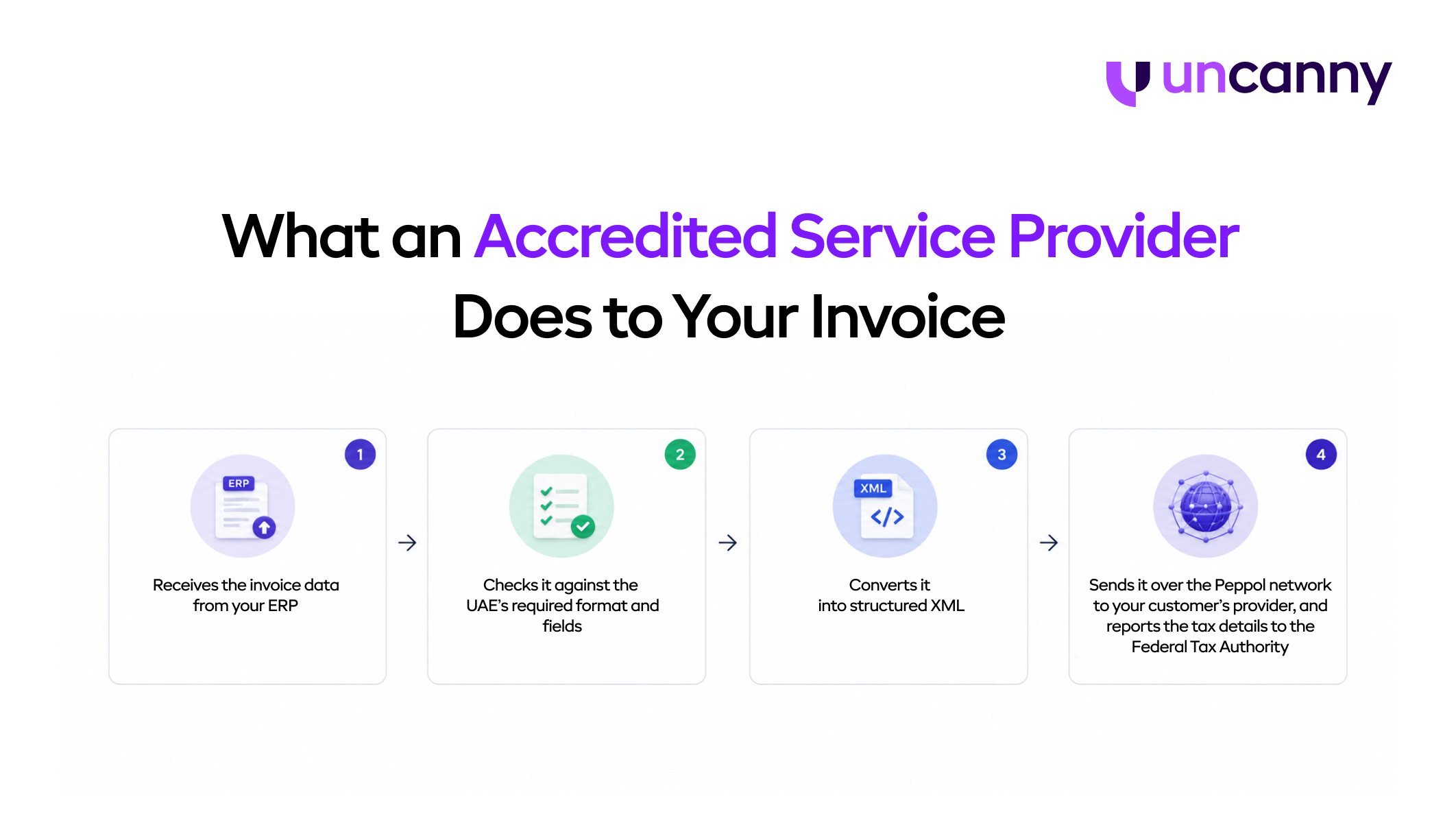
Your ASP is positioned between your accounting software and FTA. This means the ASP receives invoice data from your accounting software, checks it against the UAE PINT-AE standard, transforms it into structured XML, and sends it to your client's ASP through the Peppol network. At the same time, it sends tax information to the FTA.
To sum it up, an accredited service provider sits between your ERP and everyone else, performing the following:
- Receives the invoice data from your ERP
- Checks it against the UAE’s required format and fields
- Converts it into structured XML
- Sends it over the Peppol network to your customer’s provider, and reports the tax details to the Federal Tax Authority
Once the steps are followed, your client’s e-invoicing ASP then performs its own check upon receipt and submits the invoice to the FTA separately. The FTA then cross-checks the two submitted documents.
This is the part that needs clarification, as it changes how an invoice works. In the old system, you submitted an invoice and kept a copy. In the new system, two service providers submit a data document to the tax authority.
Quick Insight - How It Plays Out
This is how that works out. A customer record was established several years ago without a tax registration number. The PDF goes out regardless, so it wasn’t ever noticed. After go-live, the invoice gets rejected, the customer doesn't receive it, and payment terms don't kick in.
Some of these are easy to correct. Hundreds of these at month-end mean finance spends several days fixing customer records when they should be closing the books.
The service provider is the first to review each and every invoice that is generated. Data gaps once buried in the ERP now show up as late payments.
Accredited, Pre-Approved and Peppol-Certified: Understanding the Provider List
Now that you know the role of a provider, the immediate next question is: Is a given company actually allowed to do it?
The Ministry of Finance uses three terms that vendors often use interchangeably, and the differences decide whether your invoices can move.
Here’s a tabular representation:
| Status | What it means | Can it carry your live invoices? |
|---|---|---|
| Pre-approved | Passed the initial checks and can work in the testing environment | Not yet |
| Accredited | Completed the full accreditation process | Yes |
| Peppol-certified only | Certified on the international network, which the Ministry requires of applicants | Not on its own |
This usually comes up on a sales call when a vendor says it is approved; you ask which list it appears on, and the answer becomes a roadmap. If that provider is only pre-approved when your phase begins, you are paying for a service that can’t yet send your production invoices, and your appointment deadline keeps running.
The current status of e-invoicing continues to change, so a list saved in August may already be outdated. Refer to the Ministry of Finance portal on the day you sign and again before go-live. It also helps you include accreditation in the contract as a condition, with the right to exit if the provider doesn’t hold it by an agreed date.
Remember, a status checked once is only a snapshot. The contract is what protects you when it changes.
How to Compare an E-Invoicing Service Provider
Q1 - How does it connect to your ERP?
A tested connector for your exact ERP version is very different from an API the vendor calls “easy to integrate.” The first usually means weeks of configuration.
The latter can imply a customized build with its own testing period. This response will affect your schedule and budget more than any other on this list.
Q2 - Can it handle the invoices you actually issue?
A distributor that processes thousands of invoices every day has entirely different requirements than a contractor that uses staggered invoices with advance payments.
At this point, comparison breaks down because all vendors will show you how good an invoice looks. Just ask them to walk you through your difficult scenario.
Q3 - What happens when an invoice is rejected?
A good e-invoicing service provider explains the reason in plain language, routes it to the right person, and lets you resubmit without rebuilding the document. A weaker one returns a technical error code to an IT inbox that finance rarely checks. The invoice then sits unsent while each side assumes the other is handling it.
Q4 - Where is your data stored?
Invoices must be stored in the UAE according to the Tax Procedures Law. Inquire about the location, retention period, and options for exporting all the data in case you change service providers.
One more aspect of the system needs verification, which is not among the four discussed above. E-invoicing is implemented via a network; therefore, your customers' provider must be compatible with your provider. You should inquire how many service providers your customers’ provider has exchanged invoices with while testing the system.
Most differences between different e-invoicing providers become visible during failures; therefore, you should test failure scenarios rather than demonstrations.
Want to start a project with us?
Empowering businesses to achieve greatness through strategic guidance and innovative solutions.
Book A Demo
What E-Invoicing Software Costs
Once you have a shortlist, cost becomes the next filter, and that is where the numbers get confusing. Anyone searching for e-invoicing software price will find figures that can’t be compared, because the Ministry doesn’t publish provider pricing and each vendor packages its service differently.
Here’s a realistic cost estimate as per different published guides:
| Cost component | What it drives | Where the surprise appears |
|---|---|---|
| Subscription or per-invoice fee | Your volume and the pricing tier | Low at 300 invoices a month, significant at 30,000 |
| Onboarding and connectors | Number of systems connected | Some providers bundle it, others charge per system |
| ERP work | Field mapping, customization, testing | Usually billed by your ERP partner, not the provider |
| Inbound invoices | Supplier invoices arriving through the network | Some pricing models charge for receiving |
| Internal time | Master data cleanup and training | Weeks of finance and IT attention |
The usual mistake happens at the quote stage. The lowest price wins the comparison sheet. A few months after go-live, rejected invoices are being fixed by hand, support tickets are billed separately, and the cheaper provider has cost more in staff hours than a higher quote would have cost in fees.
A better measure is cost per successfully delivered invoice. Ask each vendor what a month would cost if five percent of your invoices were rejected, and who would handle them.
A quote describes the price of a working system. Your actual cost depends on how often the system doesn’t work.
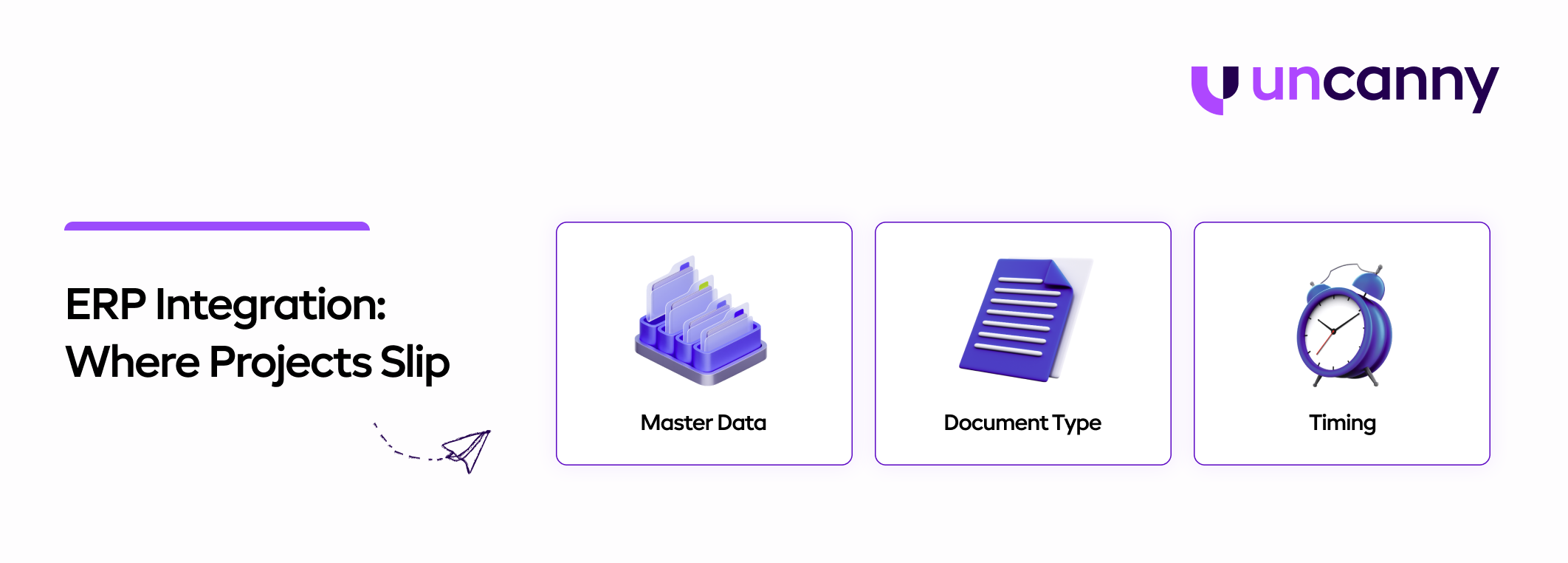
ERP Integration: Where Projects Slip
Cost estimates assume the ERP can supply what the provider needs. This section covers where that assumption fails, because integration looks like a connection task and behaves like a data task.
For each invoice, the ERP system must provide supplier and buyer tax IDs; tax codes and rates on each line item; accurate currency information; and cross-references that remain valid after posting.
Most systems keep some of this information and allow missing data because they don't require complete information before reading the PDF.
#1 Master Data
Customer data generated a number of years ago usually lacks tax IDs, has free-text addresses, and contains duplicates. The vendor will refuse each invoice individually, so finance discovers the issue during go-live, and each rejection delays payment. Preparing the customer master takes the most time and requires no vendor at all.
#2 Document Types
Each credit note, advance payment, partial delivery, and reissued invoice follows its own rules. The standard connectors are well suited to straightforward data flows, but these situations are relatively common and usually tested last. For a construction company using milestone billing, the most common type of invoice is often the one the connector handles worst.
#3 Timing
If invoices post in an overnight batch, or get edited after approval, the provider may receive something different from what the customer expects. Because tax data is reported to the Federal Tax Authority almost immediately, correcting an invoice later leaves much less room than it used to.
A practical order of work looks like this:
- Clean the customer master
- Pick your three most complicated invoice scenarios and have each shortlisted provider run them in a test environment before you sign
- Agree in writing who owns each stage, with the ERP partner on mapping, the provider on validation, and your finance team on exceptions
Without step three, one rejected invoice can move between three parties for days.
Choosing the Best E-Invoicing Software & Accredited Service Partners for Your Business - Practical Tips
All the above discussion leads to one conclusion. The search for the best e-invoicing software may seem like it has one answer, but choosing a reliable accredited services provider needs a few practical tips, namely:
- Test with real invoices: Test the provider's environment by sending 50 actual invoices (including different formats).
- Get support terms in writing: Confirm the deliverables, and ensure the team mentions the delivery milestones and response times.
- Review ERP mapping before signing the contract: Don’t onboard any provider before you’ve understood how their ERP works and maps your data.
Lastly, ask your accredited service partner a more useful question: Which e-invoicing software will cause the fewest failures in your invoice flow?
Run your most complicated scenarios through each option, confirm the provider’s status on the official list, and price the full implementation instead of the subscription alone.
Takeaway
The deadline will arrive whether or not the choice is settled, and most teams will be judged on go-live day. The real test comes weeks later, when invoice volumes return to normal, and the unusual cases start to appear.
Remember, a provider that shows those failures clearly and makes them quick to fix is worth more than one with a longer feature list.
Take the next step with UncannyCS, your go-to accredited service partners today. Book a call now.
About Author
Kamlesh Devaliya is the Vice President of Sales & Marketing at UNCANNY Consulting Services, specializing in SEO, Generative AI, AI/ML, and digital growth strategies. He helps businesses strengthen their online presence and leverage emerging technologies to achieve sustainable growth.