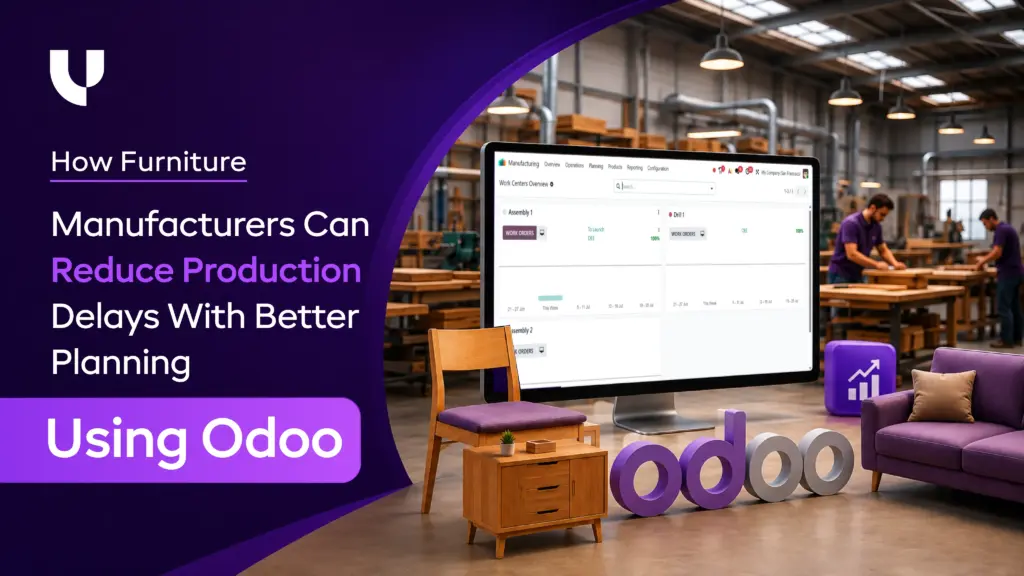
How Furniture Manufacturers Can Reduce Production Delays With Better Planning Using Odoo
Read by: 5

Sanjay Gohel
HOD Odoo
Sanjay Gohel is the Head of Department – Odoo at UNCANNY Consulting Services, specializing in ERP implementation, Odoo development, and software solutions. He helps businesses improve efficiency through customized ERP systems designed to streamline workflows and support operational excellence.

 14 Min Read
Published on July 1st 2026
Overview
Furniture manufacturers often run into problems when they are juggling between everyday production and custom orders. The disruption further complicates the workflow, resulting in losses. This blog takes a closer look at how manufacturers can reduce production delays using Odoo.
Introduction
Every furniture manufacturer has dealt with it at some point: The order is confirmed, the delivery date has been promised, and materials have been purchased.
On paper, everything looks ready, but then somewhere between planning and dispatch, things start slipping:
- A key material hasn't arrived
- One of the plants is overloaded, while the other manufacturing unit sits idle
- A task that should have been completed is still locked in production because no one noticed the issue early enough.
Most production delays don’t happen because a system fails; they stem from gaps in planning between procurement and production scheduling. These small errors further delay the shipment of the final product.
Sadly, the delays are becoming harder to manage.
According to McKinsey's 2025 supply chain risk survey, 82% of supply chain leaders reported disruptions affecting their operations, with 20%-40% of supply chain activity impacted.
At the same time, the World Bank's Global Supply Chain Stress Index data highlights that the disruption levels in early 2026 are at an all-time high for furniture manufacturers.
Therefore, in this article, we examine how production delays typically arise in furniture manufacturing. We also understand that Odoo's planning capabilities help teams identify potential issues and resolve them early.
Why Production Delays Hit Furniture Manufacturers Harder Than Most
A delay in furniture manufacturing rarely stays where it started.
- A missing material can hold up machining.
- Machining delays affect assembly
- Assembly delays push finishing schedules back.
Before long, a customer waiting for a dining table is affected by a problem that started days earlier in procurement.
That's what makes production delays particularly difficult to manage in furniture manufacturing.
a. One Delay Often Creates Several More
Unlike other manufacturing, furniture production doesn’t follow an SOP. Most products move through multiple stages, which involve different materials, teams, and suppliers.
Because those processes depend on one another, delays tend to spread quickly through the production schedule rather than remaining isolated.
b. Custom Orders Make Planning More Challenging
A standard product is relatively predictable. However, the same can’t be said for a custom order. They come in different dimensions, finishes, and materials, and unique customer requirements that need additional planning.
The more production variations a manufacturer offers, the harder it becomes for teams to communicate and execute tasks.
c. Many Teams Are Still Coordinating Through Disconnected Systems
Walk through many growing furniture manufacturing businesses, and you'll often find production schedules in spreadsheets, inventory updates shared through phone calls, and work orders moving between departments manually.
None of these tools is necessarily the problem on its own. The challenge appears when they are expected to support growing order volumes and increasingly complex production environments.
Before production delays can be reduced, manufacturers first need a clear understanding of where those delays are actually coming from.
Common Signs Your Production Planning Needs Improvement
| If this happens regularly... | It may result in... |
|---|---|
| Production starts without all the required materials | Gaps in material planning |
| One of the production units is constantly overloaded | Issues in capacity planning |
| Orders keep getting rescheduled | Limited scheduled visibility |
| Procurement is frequently rushed | Reactive purchasing process |
| Delivery dates are often revised | Disconnect between planning and execution |
Want to start a project with us?
Empowering businesses to achieve greatness through strategic guidance and innovative solutions.
Book A Demo
6 Ways Odoo Helps Furniture Manufacturers Reduce Production Delays
Most production delays don’t begin during production; they start much earlier. While you don’t see it at the start, it’s hidden in inventory blind spots, planning gaps, and procurement issues, even as production is already underway.
Here’s a closer look at how Odoo helps manufacturers identify and resolve these issues before they lead to missed delivery dates.
1. It Calculates Material Needs Before Production Starts, Not After
The production team is ready to begin a new run of dining tables on Monday morning.
The timber is available. The work orders are ready. Operators are scheduled.
Then someone notices a key component hasn't arrived.
What follows is usually a familiar scramble. Procurement checks purchase orders. The warehouse checks inventory. Production tries to reshuffle work so the day isn't completely lost.
The delay may have started with a missing material, but the disruption quickly spread across the schedule.
How Odoo helps
Odoo offers MRP modules for manufacturers, allowing them to estimate demand based on confirmed sales and planned production sprints. It allows teams to uncover production shortages before they start, helping them identify gaps much earlier, before delivery is affected.
How Uncanny helps
Uncanny configures lead times, reorder rules, and replenishment triggers around each manufacturer's supplier network and purchasing behaviour.
This ensures planning reflects real-world supplier performance rather than default system assumptions.
2. It Schedules Work Centers Against Real Capacity, Not Assumptions
Walk through a furniture factory on a busy week, and you'll often see the same pattern.
One machine has a queue of jobs waiting for processing. Another sits unused for part of the day. The schedule looked reasonable when it was created.
However, the problem became visible only once production began moving through the factory. Operations start to get delayed, the workflow is unable to handle urgent orders, and suddenly, one team is managing more work than the other.
How Odoo helps
Odoo offers Work Center scheduling tools that enable businesses to plan and build deliverables. It allows you to analyze machine capacity, operator availability, and production workloads. What’s more? The module further allows manufacturers to address potential bottlenecks before they become problems.
How Uncanny helps
Team Uncanny works closely with manufacturers to understand their daily operations. We map workflows and machine capacity, understand shift structures and scheduling constraints, and configure Odoo to align with your operations.
We ensure production schedules reflect the actual workflow in the factory rather than relying on generic assumptions.
3. It Gives Production Managers Live Status Across Every Open Order
A wardrobe order is marked as "in production."
Ask three departments where it actually is, and you may get three different answers.
Production believes the machining work is complete. The assembly is waiting for components. Finishing has not seen the order yet. Everyone is working, but nobody has a complete picture of what is happening.
This becomes more common as order volumes increase. Furniture orders move in multiple stages, and a delay in one section can affect operations in another. By the time the team tracks down and resolves the problem, the entire delivery is halted, resulting in production delays and potential loss.
How Odoo helps
Odoo allows furniture manufacturers to stay up to date on their operations in real time. It allows business owners to track work orders, inventory movement, and overall manufacturing progress from a single dashboard.
With Odoo, production managers have a real-time insight into:
Current stage of the order
What stage has been completed
Whether any operation is waiting on materials, labor, or another process
This allows teams to resolve bottlenecks in real time rather than discovering delays when production pauses.
How Uncanny helps
Uncanny configures production workflows and reporting based on how each manufacturer runs its shop floor. This ensures teams are tracking meaningful production milestones rather than generic status updates.
Improved production visibility, faster issue identification, and fewer delays caused by information gaps.
4. It Turns Procurement Into a Planned Activity, Not a Fire Drill
Here’s a common scenario for growing furniture manufacturers: A truck arrives with timber on Wednesday, but the factory needs it on Monday.
The problem didn't begin with the delivery; it started much earlier.
Such delays are common when different data sets move among the purchase, inventory, and production teams. Here’s what happens during such instances:
- Procurement believed there was enough stock available.
- Production assumed new materials had already been ordered.
- By the time everyone realized there was a gap, the schedule had already been affected.
These instances are common when your team relies on manual updates or spreadsheets to procure new stock. The materials eventually arrive, but production has already lost time waiting for them.
How Odoo helps
Odoo connects procurement and production teams together. It enables teams to generate sales orders, production plans, and material demand in real time, providing real-time procurement insights. This provides teams with more visibility into what to order and when to order rather than reacting to last-minute requests from the shop floor.
How Uncanny helps
Team UncannyCS helps furniture manufacturers to set procurement rules, accounting rules for different suppliers, and material catalogs, based on purchase behavior.
With each aspect of manufacturing assigned specific rules for procurement, inventory, and delivery, businesses experience fewer shortages, fewer emergency purchases, and more reliable production schedules.
5. It Lets Planners Model Schedule Changes Before Committing to Them
An important custom order comes in and needs to be prioritized.
On the surface, the decision seems simple. Move the new job forward and keep the customer happy.
The problem is that every production schedule is connected to dozens of other commitments. Moving one order may affect machine availability, labor allocation, material requirements, and delivery dates for other jobs already in progress.
Many manufacturers only discover the impact after the schedule has been changed. By then, one urgent order had caused delays elsewhere in the factory.
How Odoo helps
Odoo provides visibility into production workflows, current orders, manufacturing plants, and available resources before any schedule changes are made. This way, instead of making random adjustments, teams can gain clear insights into what needs tweaking and when.
How Uncanny helps
Our Odoo experts work closely with manufacturers to configure workflows that reflect their actual production. We replicate every aspect of your plant, from custom orders to delivery commitments, to deliver custom solutions that ensure scheduling decisions are based on operational realities rather than assumptions.
We help you minimize scheduling conflicts, improve coordination between teams, and switch priorities without sacrificing efficiency.
6. It Connects Sales Commitments to What the Floor Can Actually Deliver
A delivery date is promised before production has had a chance to review the workload.
Sales believes the timeline is achievable. Production is already managing a full schedule. Procurement is waiting on materials for several existing jobs.
Nobody intended to create a problem.
The issue is that each team is working from a different view of the business. What looks achievable from one department may be unrealistic once machine capacity, material availability, and active production orders are considered together.
The result is often a missed delivery date that could have been avoided much earlier.
How Odoo helps
Odoo integrates sales, production, inventory, and procurement into a single system. Delivery commitments are supported by actual production capacity, material availability, and active workloads, rather than by isolated estimates.
When schedules change, materials are delayed, or new orders are added, the information becomes visible across teams, helping everyone work from the same picture.
How Uncanny helps
Uncanny helps manufacturers align sales processes with production planning during implementation, ensuring delivery commitments are based on how the factory actually operates. This creates better coordination between customer expectations and manufacturing capacity.
More reliable delivery dates, improved communication between departments, and fewer delays caused by planning disconnects.
How Uncanny Makes Odoo Work For Furniture Manufacturing
Choosing Odoo for your furniture manufacturing operations is only part of the project. The bigger question is whether the system reflects what actually happens during production within the factory.
Here’s a closer look at how UncannyCS aligns Odoo with your furniture manufacturing workflows:
#1 A Furniture Factory Rarely Produces the Same Thing Twice
Being a furniture manufacturer, you come across these instances almost regularly:
- A customer requires a walnut finish instead of oak.
- Another customer wants different dimensions for their products.
- A third wants a different finish after the order has been approved.
Such minor changes have a significant impact on bills of materials, procurement, and delivery timelines. If these metrics aren’t set up properly, the business may face planning problems after go-live.
#2 Production Doesn’t Move Through A Straight Line
Before a piece of furniture is ready to ship, it may be cut, machined, assembled, finished, inspected, and packaged.
Each manufacturer does those stages a little bit differently. Uncanny maps those production flows before configuring Odoo, so the system reflects how work actually flows through the factory rather than forcing teams into a one-size-fits-all process.
#3 Supplier Relationships Matter Just As Much As Production Planning
Some suppliers ship within days, while some take weeks to complete the same task. Similarly, some materials are only available from certain vendors.
These details directly impact purchasing and production planning. In implementation, Uncanny sets lead times, procurement rules, and inventory planning parameters based on how suppliers actually work.
One Team Steers the Entire Journey
As an official Odoo-licensed partner, Uncanny provides official licensing, implementation, training, and post-go-live support as a single team.
With UncannyCS, you get a team of professionals who help throughout your operations - from planning and configuration to day-to-day support post go-live.
The Right Planning System Ends Production Delays in Furniture Manufacturing
Most production delays don't start on the shop floor; they begin much earlier via missed material requirements, overloaded work centers, or disconnected schedules.
Most manufacturing businesses forget to evaluate the small details until they impact production timelines.
But the good news is that these problems are not inevitable.
These hurdles can be streamlined with smart planning and often avoided before they pause production.
For furniture manufacturers scaling their brand, better planning is no longer a must-have. It's what separates predictable operations from constant firefighting.
If you're evaluating Odoo for your furniture manufacturing business, UncannyCS can help you build a system that fits how your factory actually runs. Book a call with our experts today!
FAQs
Q. What are some of the most common production delays in furniture manufacturing?
Production delays result from miscommunication between teams. They generally result from delays in inventory updates, scheduling, and procurement, among other factors. While these factors might cause minor issues individually, together, they can bring the entire workflow to a halt.
Q. How does Odoo's MRP module help furniture manufacturers plan material requirements in advance?
Odoo’s MRP module allows business owners to estimate the cost of materials required for production. These estimates are based on current inventory levels, bills of materials, and materials used in production. Together, these factors give teams a real-time view of stock updates before a major production delay.
Q. Can Odoo handle production scheduling for custom and made-to-order furniture?
Yes, Odoo supports production scheduling for custom and made-to-order furniture. It distinguishes products by materials, finishes, dimensions, and other unique requirements, enabling teams to plan production while managing both regular and custom client requirements.
Q. How does Odoo give production managers real-time visibility into the shop floor status?
Odoo brings together every aspect of production - from procurement to distribution under one platform, allowing teams to have a clear insight into the floor operations in a single dashboard.
Q. What is the role of MRP and ERP? What does a manufacturer require?
MRP (Material Requirements Planning) is concerned mainly with material management in production operations. On the contrary, ERP (Enterprise Resource Planning) connects manufacturers to every part of their operations, from planning to production.
Q. How long does it take to see improvements in on-time delivery after implementing Odoo?
The timeline varies depending on the workflow your business uses. Many manufacturers start to see improvements in their operations once the ERP is implemented, while some owners need further customization before they see results.
Q. Why should a furniture manufacturer implement Odoo through a licensed partner like Uncanny rather than directly?
Implementing the software is only a part of the job, but customizing it to align with your operations - that’s where UncannyCS steps in. As an official Odoo partner, we help you leverage every aspect of Odoo, from migration to go-live and future support as you scale.
Found this post helpful? Be sure to share it with your network!


About Author
Sanjay Gohel is the Head of Department – Odoo at UNCANNY Consulting Services, specializing in ERP implementation, Odoo development, and software solutions. He helps businesses improve efficiency through customized ERP systems designed to streamline workflows and support operational excellence.


Sanjay Gohel is the Head of Department – Odoo at UNCANNY Consulting Services, specializing in ERP implementation, Odoo development, and software solutions. He helps businesses improve efficiency through customized ERP systems designed to streamline workflows and support operational excellence.