7 Challenges Growing Ecommerce Brands Face and How Shopify and Odoo Solve Them
Published on September 3rd 2026
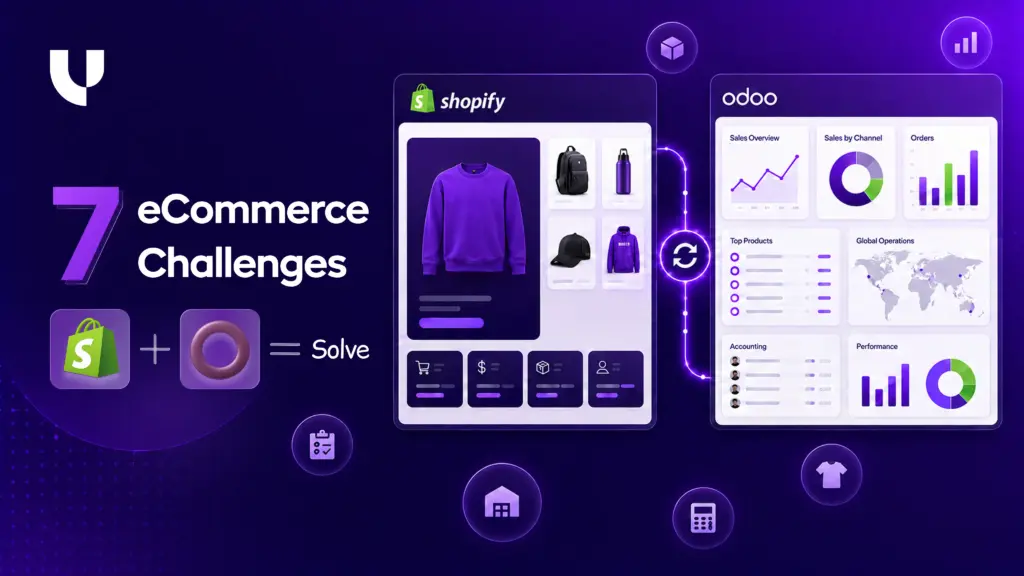
Overview
Reports by Shopify suggest that the eComm giant helped merchants generate $14.6 billion in sales during Black Friday-Cyber Monday 2025. What started as a small service provider now powers eCommerce stores for over 6.8 million owners.
That kind of volume changes what happens behind the storefront. More orders mean more inventory movements, more fulfillment work, more financial transactions, and more data that needs to stay accurate.
Introduction
Shopify can handle the customer-facing side of a growing eCommerce business very well. The problems usually start somewhere behind it.
Inventory may be managed in one place, accounting in another, and warehouse teams may use their own system to get orders out the door. At first, that setup may be manageable. As order volumes and product ranges increase, keeping everything aligned becomes harder.
This is where Shopify and Odoo integration makes the difference for business owners.
Shopify continues to handle the front end and customer experience while Odoo continues to run the operational aspect of the business. The connector stores important information instead of moving it between systems and having the team run operations manually.
This article looks at seven common challenges that appear as eCommerce brands grow and where Shopify, Odoo, and a connected setup can help.
Why Growing eCommerce Brands Outgrow Shopify Alone
Shopify can continue handling the storefront as a business grows. The harder part is everything happening around the storefront.
Growth Adds More Than Orders
More orders also mean more inventory movements, purchase orders, warehouse activity, returns, customer records, and financial transactions. A setup that worked when the business was smaller can feel very different once all of that happens at a much higher volume.
Separate Systems Start Creating Extra Work
This is usually where businesses add tools to fill the gaps. Accounting might sit in one system, inventory in another, and warehouse teams may work from yet another. None of those tools has to be bad for the problem to appear; the issue is that the same information now has to move between them.
- Someone has to reconcile inventory.
- Someone has to pass order information to the warehouse.
- Finance needs sales data.
- Returns need to be reflected in more than one place.
Where Shopify and Odoo Fit Together?
Shopify and Odoo together are a great option for businesses that need to manage both front-end and customer experiences as they scale. Shopify helps brands manage customer engagement and interactions while Odoo handles accounting, inventory, purchase order management, and other back-end processes.The Shopify-Odoo integration allows these two platforms to exchange the data they need for their respective sides. Let’s learn more about it with these seven challenges.
Want to start a project with us?
Empowering businesses to achieve greatness through strategic guidance and innovative solutions.
Book A Demo
7 Challenges Faced by Growing eCommerce Brands
Once an eCommerce business scales to more products and customers, teams feel the pressure on the backend as well.
Here are seven areas where growing brands commonly start running into trouble.
1. Keeping Inventory Accurate Across Channels
As an eCommerce brand grows, inventory starts moving through more places. Shopify, marketplaces, physical stores, and different fulfillment locations can all be selling from the same pool of stock.
The problem is what happens when those numbers don't agree. A product may still appear available online after it has already been reserved elsewhere, leading to overselling, canceled orders, and unnecessary customer service work.
Shopify and Odoo's Role
Shopify keeps the storefront and customer orders moving, while Odoo can manage the inventory behind them, including stock received, reserved, transferred, and fulfilled.With a Shopify Odoo connector, the two systems can share inventory and order information instead of your team updating both separately.
That gives growing brands a much clearer view of available stock and reduces the manual checking that becomes difficult as order volume increases.
2. Managing Increasing Order Volumes Efficiently
More orders are a good sign, but they can expose weak spots in the way an eCommerce operation is organized. What worked when the team was processing a few hundred orders can become difficult when that number grows several times over.
Picking lists, order status updates, shipping information, and customer notifications can quickly turn into a lot of manual work. The warehouse may be waiting for information that sales already has, or the customer may see an order status that is no longer accurate.
Shopify and Odoo's Role
Shopify can continue to receive orders while Odoo manages the backend, from order fulfillment to inventory updates.With Odoo eCommerce integration, order information can move into the operational system without someone having to re-enter it. That gives the warehouse a clearer list of what to pick and ship as order volumes increase.
3. Keeping Shopify and Back-Office Data in Sync
The storefront may be where the order starts, but a lot more happens after a customer clicks Buy. Inventory needs updating, the warehouse needs the order, finance needs the transaction, and customer records may need to change too.
When these systems aren't connected, teams end up moving information between them. That's manageable for a while. As orders and products grow, it becomes another source of mistakes and delays.
Shopify and Odoo's Role
Shopify can serve as the front end for customer engagement. It lets buyers explore the store and order products, while Odoo manages product and order records.A Shopify Odoo connector lets teams sync every aspect of product, customer, order, and inventory in a single platform, so they don’t have to store similar information across multiple databases. It also simplifies data management by eliminating duplicate copies.
4. Connecting eCommerce Sales With Accounting
As order volume grows, the finance team has more than just invoices to keep up with. Sales, refunds, payment records, taxes, discounts, and fees all need to make their way into the accounts correctly.
When Shopify and accounting are kept apart, someone usually has to export information, clean it up, and make sure the numbers match. That may work at a smaller scale, but it gets harder when orders and transactions are coming in every day.
Shopify and Odoo's Role
Shopify can continue handling the customer-facing sale, while Odoo Accounting manages the connected financial records. With Shopify-Odoo integration, order and transaction information can move from Shopify into Odoo, giving the finance team the information it needs without repeated manual entry.Teams can match sales records with raised invoices, taxes, and other payments. Instead of accounting for Shopify sales separately, business owners can manage all their finances in one place. This feature becomes particularly useful when reconciling manual orders takes more time for a growing business.
5. Scaling Fulfillment, Warehousing, and Returns
Getting orders out on time gets harder when hundreds or thousands move through the warehouse. The same goes for returns. Someone has to receive the item, check its condition, update the stock, and make sure the customer's refund is reflected correctly.
This is also where multiple warehouses can make things messy. The store may show stock as available, while the team handling the order is looking at a different number.
Shopify and Odoo's Role
Shopify can keep the customer side of the order moving, while Odoo gives the operations team a place to handle the warehouse work. The team can process picking and packing, manage stock between locations, and handle returned products on the operational side.A Shopify Odoo connector keeps the order information tied to that process. Once an order comes through Shopify, the warehouse doesn't need to recreate it somewhere else. Updates made during fulfillment can also flow back to the Shopify order.
For a growing brand, that means fewer orders sitting between the storefront and warehouse waiting for someone to move the information along.
6. Managing Complex Products, Variants, and Multiple Stores
As a store grows, the product catalog can become difficult to manage. A single product may have different sizes, colors, materials, or other variants, each with its own stock and product information. Then multiple storefronts or sales channels use some of the same products.
What starts as a simple catalog can turn into a lot of updating. A price changes in one place, a variant goes out of stock somewhere else, or a new product is added to one store but not another. The more versions of the catalog a team maintains, the easier it becomes for something to get missed.
Shopify and Odoo's Role
Shopify can manage the products and variants customers see, while Odoo can handle the wider product and inventory information behind those sales. With Shopify-Odoo integration, product and stock information can move between the systems instead of being maintained separately.This is especially useful for brands running multiple stores or carrying many variants. Customers still get the Shopify experience, while the operations team has a central place to manage the information behind it.
7. Getting Real-Time Visibility Into eCommerce Operations
Once an eCommerce store scales to a certain extent, sales volume alone isn’t enough. Operations teams need transparency in the process, with real-time updates on inventory, fulfillment, purchases, and cash flow.
The problem is that these numbers can tell different stories when they are scattered across different platforms. A Shopify report may show what customers ordered, while the warehouse has a different stock figure and finance is working from another set of records. By the time those numbers are reconciled, the situation may have already changed.
Shopify and Odoo's Role
Shopify gives businesses clear insight into sales and customer activity, while Odoo can centralize that information. With Shopify Odoo integration, teams can spend less time pulling reports from separate systems and more time working with the information itself.For management, that means decisions are based on what is happening across the operation, not just what is happening inside the Shopify store.
How Shopify and Odoo Solve These eCommerce Challenges
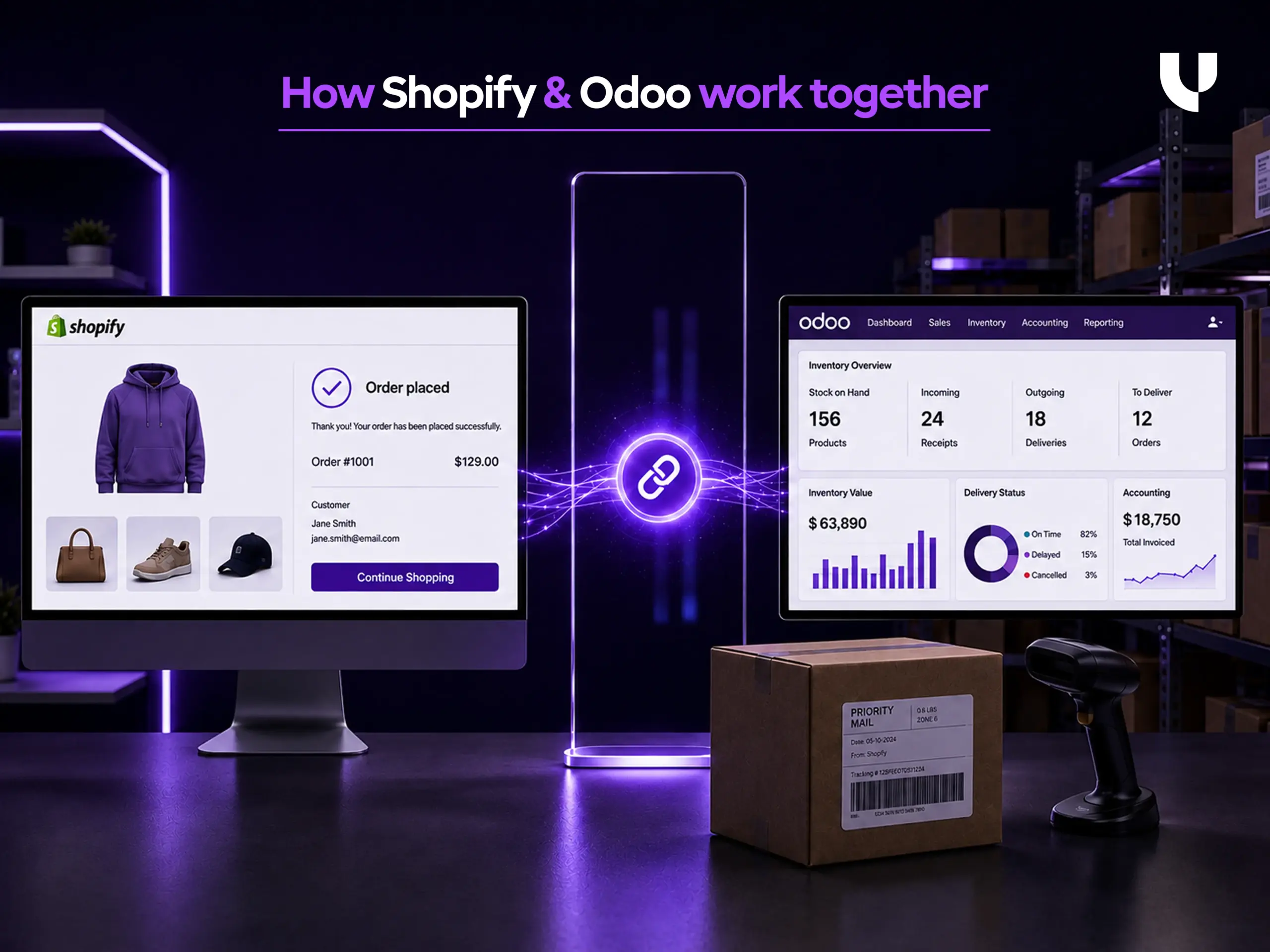
For businesses facing similar challenges, you don’t need to replace Shopify; you can add an integration layer. In most cases, it’s best to let each software manage different aspects of operations and integrate them later for transparency across the workflow.
Shopify for eCommerce and Customer-Facing Sales
Shopify remains the front end visible to buyers where they can explore products, make payments, and manage orders. The platform also lets business owners manage customer operations, product categories, and the overall checkout experience.
For a growing eCommerce brand, there is no reason to move that customer-facing experience simply because the operation behind it has become more complicated.
Odoo for eCommerce Operations and Back-Office Management
Odoo can handle the work happening behind the storefront. The ERP maintains data on inventory, purchasing, warehouse operations, and other accounting functions.
This lets operations and finance teams access a system built around the business itself, rather than accessing Shopify for every back-office requirement.
Shopify Odoo Integration for Connected Operations
Both platforms are more useful when they aren't treated as individual software. The Shopify Odoo connector allows you to transfer data such as products, orders, customers, and inventory from Shopify to Odoo.
Shopify still handles sales, while Odoo handles everything that comes after. Customers get the Shopify experience, and store managers get the integrated data they need.
How a Shopify Odoo Connector Supports Scalable Growth
The connector sits between Shopify and Odoo and passes the information each side needs. That can include products, orders, customers, stock, fulfillment updates, and financial information.
The useful part is that the team doesn't have to treat Shopify and Odoo as two completely separate systems.
-
Real-Time Updates Around Operations:
A product added or updated in Shopify may also need to exist in Odoo. The same applies to customers and orders, while inventory needs to move in the other direction as stock changes. -
Keeping Store and ERP Data Aligned:
A Shopify Odoo connector lets businesses sync data across platforms. For instance, orders received on Shopify update the backend in Odoo, keeping stock and store information in one place. -
Automated Fulfillment, Shipping, Returns, and Refunds:
Once an order is placed, Odoo can take over operations. Shipping, returns, and refunds can then be pushed back to Shopify, keeping the customer order and back-office record aligned. -
Centralized Data for Inventory, Accounting, and Reporting:
Shopify handles the sales data, while Odoo brings in inventory, purchasing, fulfillment, and accounting. Connecting the two gives the business one place to work with the operational information behind its online sales.
When Shopify and Odoo Integration Makes Sense
Shopify can be a great option for businesses that have scaled beyond a certain level. The real question is whether your workflow can keep up with the front-end.
Signs Your Shopify Store Has Outgrown Its Current Setup
You may be reaching that point if:
- Inventory needs frequent manual checks.
- Orders or customer details are entered more than once.
- Finance spends too much time reconciling Shopify sales.
- Warehouse teams lack current stock or order information.
- Returns and refunds require several manual updates.
- Spreadsheets are holding the operation together.
When Odoo eCommerce Integration Can Improve Scalability
Odoo eCommerce integration is a great option for businesses when Shopify remains your front end, but the backend is facing scalability issues.Odoo can continue handling store management, while Shopify can handle inventory management, purchase management, accounts, fulfillment, and other aspects of running the business. A Shopify-Odoo connector will handle the flow of necessary information between them.
This means growing brands won't need to change their store simply because their business has become more complex.

About Author
Jigar Jariwala is the Delivery Head at UNCANNY Consulting Services with expertise in Shopify, Mobile App Development, WordPress, and website design. He helps businesses build customer-centric digital experiences that drive engagement, improve online performance, and support long-term growth.